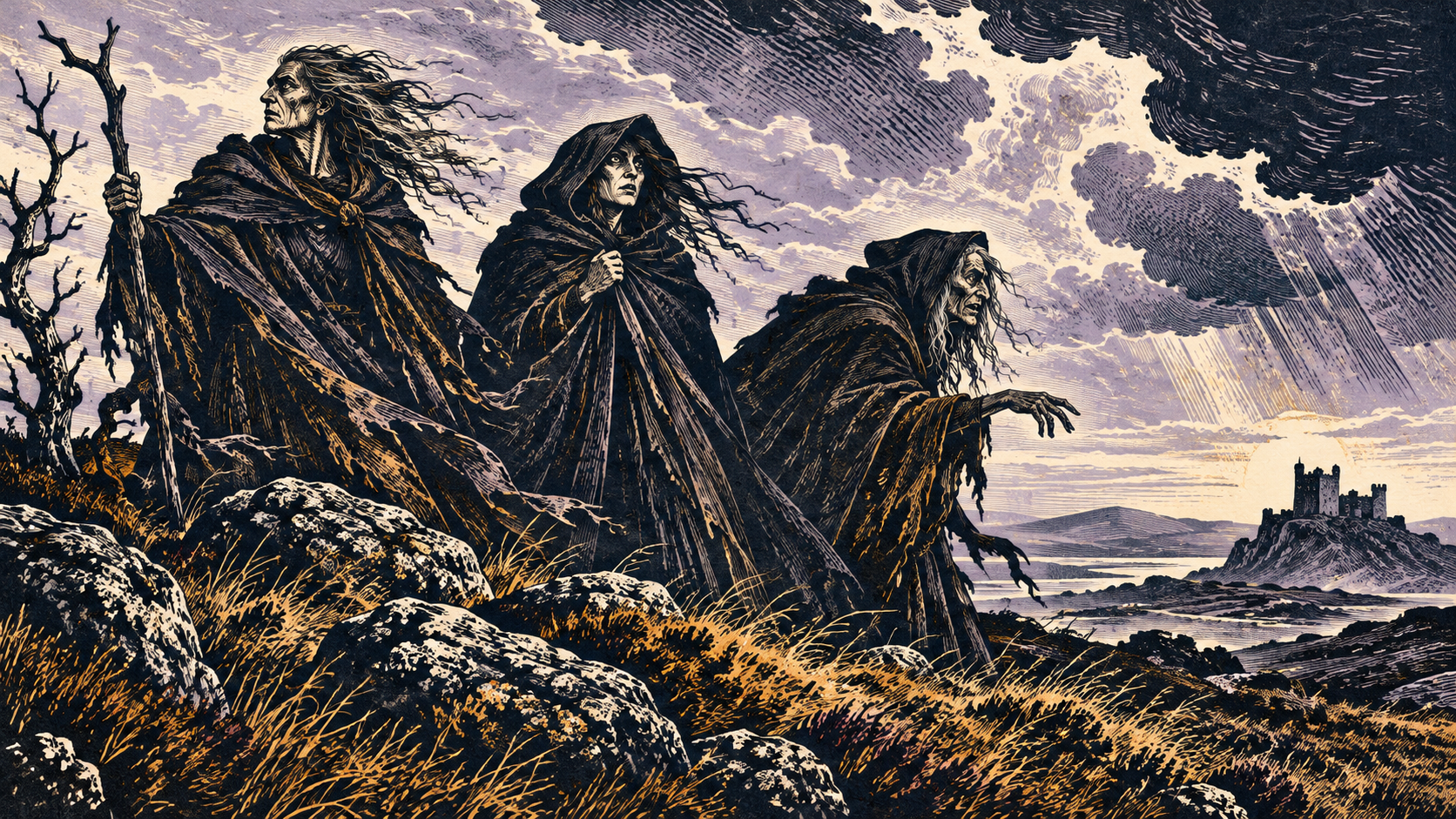
The supernatural in Macbeth gives ambition a tempting voice, turns private fear into something the audience can watch, and offers promises that Macbeth disastrously misreads. Shakespeare connects strange events to decisions: the witches suggest a future, Macbeth chooses how to pursue it, and later visions disturb the security he hoped to gain.
A useful essay follows that changing relationship. Ask what each supernatural moment makes Macbeth believe, how Shakespeare presents it, and what happens because of his response. The quotations below show a movement from temptation through guilt to false confidence, with room for different interpretations of what the characters see.
The witches make appearances difficult to trust
“Fair is foul, and foul is fair”
The witches speak this line in Act 1, Scene 1, before Macbeth appears. The reversed order of “fair” and “foul” makes each quality turn into its opposite. Attractive things may conceal danger; something apparently dreadful may offer an enticing reward. The compact, chant-like line gives that confusion a memorable sound.
This prepares us for the witches’ greeting of Macbeth as “king hereafter” in Act 1, Scene 3. When the news that he is Thane of Cawdor follows their prediction, their words acquire credibility. Macbeth begins treating a possible future as an invitation to action. Shakespeare lets the audience watch the gap between what the witches say and what Macbeth supplies for himself.
Banquo offers a competing response: “The instruments of darkness tell us truths” (Act 1, Scene 3). “Instruments” suggests agents serving a harmful purpose, while “truths” explains why they are persuasive. A correct detail can win trust that later becomes dangerous. Banquo’s warning gives the scene an alternative interpretation that Macbeth has heard and can choose to consider.
Lady Macbeth asks the spirits for cruelty
“Come, you spirits”
In Act 1, Scene 5, Lady Macbeth actively calls on supernatural powers. The imperative “Come” makes her speech an urgent summons. Her request to “unsex me here” expresses a wish to escape qualities she associates with womanhood, especially compassion and nurturing. Her later demand for “direst cruelty” makes the desired change explicit.
Focus on the purpose of that appeal. She wants to prevent remorse from weakening the plan to kill Duncan. Shakespeare presents a character trying to reshape her own capacity for violence through the language of possession and transformation. The scene gives us her request; it leaves any actual intervention by spirits unconfirmed.
This distinction helps an essay remain precise. You can argue that the invocation reveals her determination to suppress pity. Claiming that the spirits demonstrably remove her conscience would need evidence the scene does not provide. Her later distress also complicates any assumption that this wish has secured permanent emotional control.
The dagger gives Macbeth’s conflict a visible shape
“A dagger of the mind, a false creation”
Macbeth considers this explanation in Act 2, Scene 1, shortly before murdering Duncan. His opening question, “Is this a dagger which I see before me”, makes uncertainty central to the speech. He tries to grasp the object and compares sight with touch, testing an experience that feels convincing.
The phrase “of the mind” locates one possible origin inside Macbeth. “False creation” suggests an image produced by his strained imagination. The dagger points towards the murder he is already preparing to commit, making his intention appear outside him. Shakespeare gives a private struggle the shape of a weapon.
A production can choose whether the audience sees an object or watches Macbeth reach into empty space. Either choice directs attention to perception. The language supports a psychological reading, while the play’s wider supernatural atmosphere allows the vision to feel ominous. Treating it as a confirmed message sent by the witches goes beyond what Macbeth’s speech establishes.
For closer practice with the relationship between a scene, its language and your interpretation, explore our Macbeth course.
Banquo’s ghost turns private guilt into public disorder
At the banquet in Act 3, Scene 4, Macbeth reacts to the ghost of Banquo, whose murder he has arranged. The royal gathering should display his authority. Instead, his responses interrupt the occasion and expose a fear his guests cannot understand.
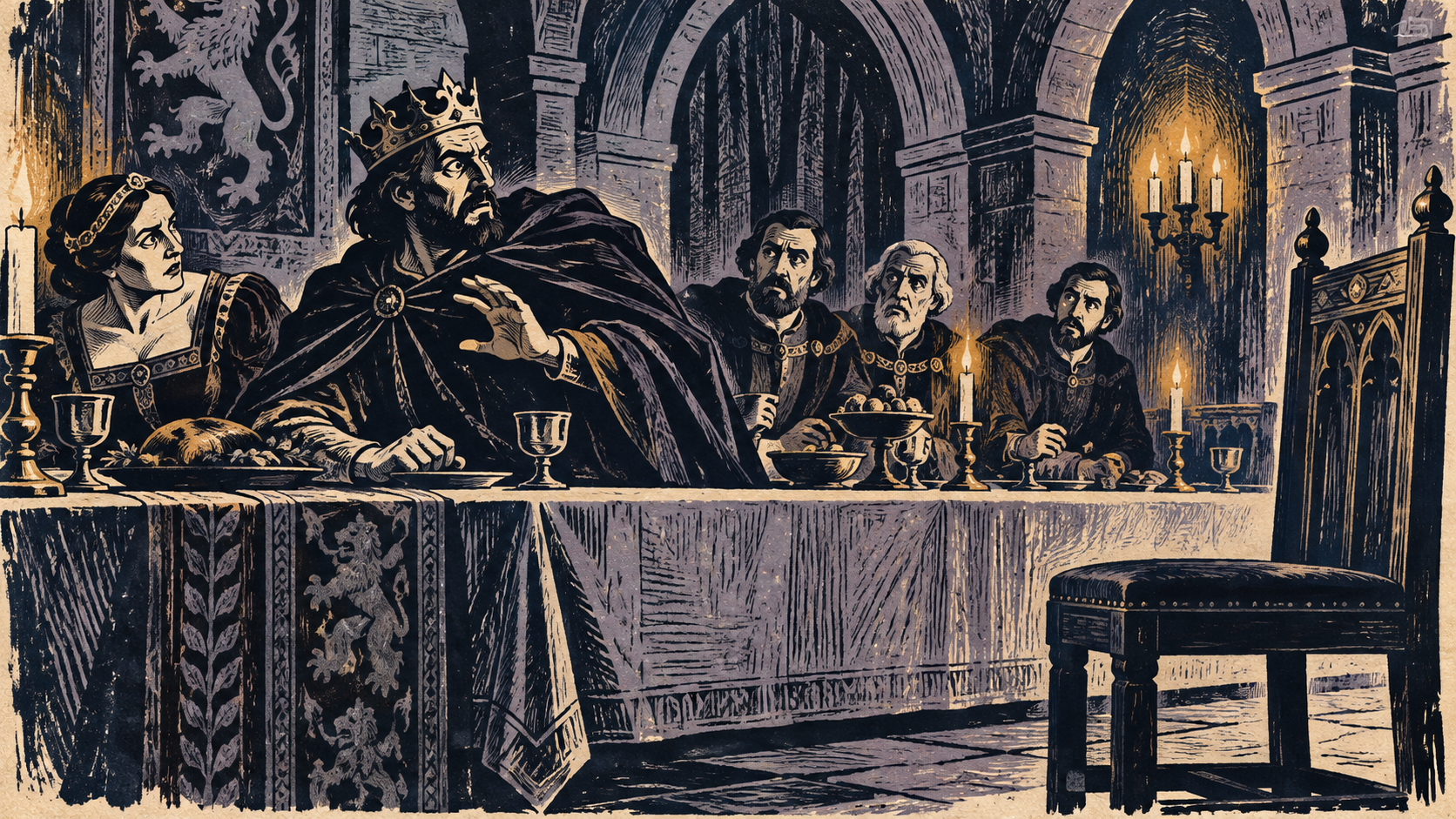
“Thou canst not say I did it. Never shake
Thy gory locks at me.”
Macbeth’s denial immediately introduces the accusation he fears. He employed murderers, so the wording can sound like an attempt to distance himself from responsibility. The command “Never shake” also shows him trying to control a figure that has disrupted his carefully arranged evening. “Gory” brings the violence back into the supposedly civilised feast.
The scene separates Macbeth’s experience from everyone else’s. Lady Macbeth sees a stool; the guests see their king behaving strangely. The ghost has an entrance in the play’s stage directions, so it is worth allowing for its theatrical presence alongside an interpretation centred on guilt. Shakespeare makes Macbeth’s isolation playable: people share a room while experiencing radically different events.
The resulting disorder has political consequences. Lady Macbeth must manage the gathering and eventually dismiss the guests. Macbeth has gained the crown, yet his fear prevents him from performing the calm authority the banquet requires.
The apparitions offer reassurance with a hidden trap
“none of woman born
Shall harm Macbeth”
The bloody child speaks this assurance in Act 4, Scene 1. An earlier apparition has warned Macbeth about Macduff, but this apparently sweeping promise encourages him to believe he is protected. He responds to language that suits his desire for safety while still planning further violence.
The promise depends on equivocation: wording that allows a deceptive double meaning. Macbeth understands “woman born” as covering every possible human opponent. In Act 5, Scene 8, Macduff reveals that he was taken from his mother’s womb “Untimely ripp’d”. The play uses that exceptional birth to overturn Macbeth’s interpretation of the assurance.
The Birnam Wood prophecy works similarly. Macbeth expects a forest’s movement to be impossible, but Malcolm’s soldiers carry branches to conceal their numbers. A condition Macbeth dismisses becomes a military action. The supernatural predictions shape his expectations, and ordinary human decisions bring about their fulfilment.
By the final confrontation, Macbeth recognises that the fiends “palter with us in a double sense” (Act 5, Scene 8). “Palter” suggests deceptive dealing. His recognition comes after the promises have helped sustain his confidence. Shakespeare makes the cost of a comforting interpretation painfully clear.
From prediction to consequence
Follow what the supernatural does to Macbeth’s judgement at each stage.
1. Temptation
Witches, Act 1
A confirmed title makes a promised crown persuasive. Macbeth begins imagining murder.
2. Conflict
Dagger, Act 2
An uncertain vision gives his intended violence an outward shape.
3. Exposure
Ghost, Act 3
Private fear disrupts a public display of royal authority.
4. False security
Apparitions, Acts 4–5
Double meanings encourage confidence that the final events overturn.
Turn a quotation into an argument
Choose a precise claim, examine a word or dramatic choice, then explain the consequence. For example:
Shakespeare presents supernatural reassurance as a danger to Macbeth’s judgement. The promise that “none of woman born” can harm him sounds universal, encouraging him to imagine complete protection. Its later reversal through Macduff’s birth exposes the gap between the words and Macbeth’s hopeful reading of them.
Build your own paragraph by comparing the dagger with Banquo’s ghost. Who can see each vision? What is Macbeth preparing to do, or trying to conceal? Use those differences to explain how Shakespeare moves from private conflict to public disruption. Returning to the scene after writing often reveals a detail your first reading hurried past.
The supernatural changes its dramatic role as Macbeth pursues and defends his crown. Following that movement gives your essay a developing argument. Our Macbeth course offers scene explanations and writing practice to help you connect Shakespeare’s language with the choices unfolding onstage.