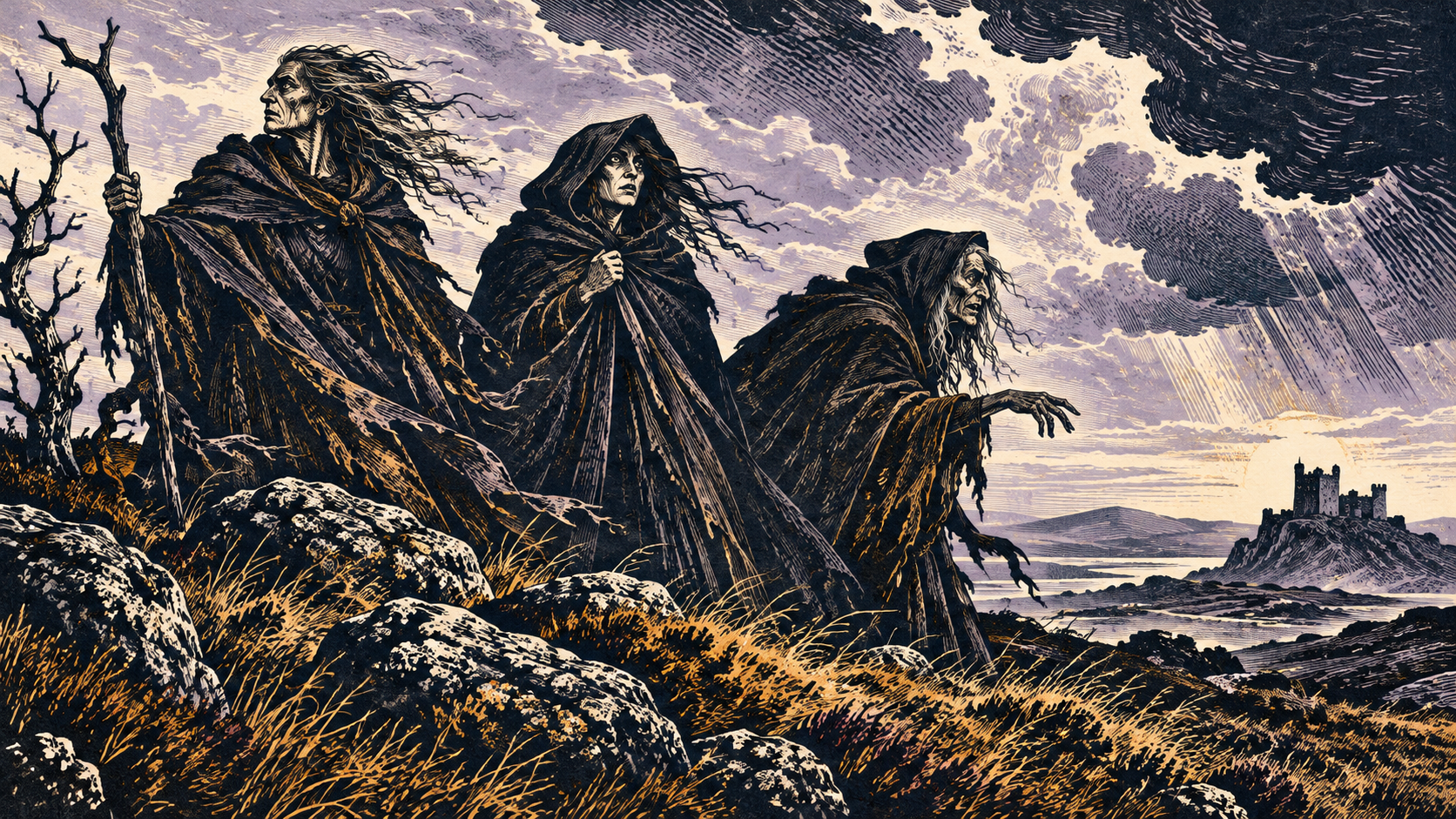
Macbeth changes from a celebrated soldier serving Scotland into a king who uses murder to protect his power, then faces defeat with exhausted defiance. Ambition starts that movement; fear helps sustain it. Across the play, his willingness to act violently grows as his relationships and sense of purpose deteriorate.
To explain how Macbeth changes throughout the play, follow his decisions alongside his language. A character arc is the pattern of development a character undergoes. Macbeth’s arc includes hesitation and reversals: the confident warrior remains vulnerable to imagined danger, even after he has become a ruthless ruler.
Act 1: a soldier whose violence earns honour
Shakespeare introduces Macbeth through other people’s reports. The wounded Captain calls him “brave Macbeth” in Act 1, Scene 2, while describing his brutal defeat of a rebel. Duncan rewards his service with the title of Thane of Cawdor. Macbeth begins the play with a reputation for courage and loyalty.
That opening establishes a revealing continuity. Macbeth already knows how to kill. His later development changes the purpose of his violence: the soldier defending Duncan’s kingdom becomes the man who attacks its king. An essay can trace that shifting allegiance while acknowledging the strength that survives through the tragedy.
Notice the dramatic method, too. Before Macbeth speaks for himself, we hear the public version of him. Shakespeare then opens up the private thoughts that complicate that reputation.
Act 1: ambition meets an active conscience
The witches’ prediction of kingship gains credibility when Macbeth receives the title of Cawdor. In Act 1, Scene 3, he considers allowing chance to crown him, although the thought of murder has already disturbed him. His future still contains alternatives.
When Duncan names Malcolm his successor, Macbeth asks, “Stars, hide your fires” (Act 1, Scene 4). The imperative reveals a wish to conceal his desires. Darkness becomes useful because he understands that those desires conflict with his public loyalty.
His soliloquy in Act 1, Scene 7 makes that awareness explicit. He weighs his duties as Duncan’s subject, relative and host, and recognises his own “Vaulting ambition”. The image suggests a force that can overshoot its aim. He temporarily abandons the plan, then accepts it after Lady Macbeth challenges him. Shakespeare gives the murder a history of conscious deliberation.
Act 2: the murderer struggles with what he has done
After killing Duncan, Macbeth is overwhelmed by sounds, religious anxiety and the sight of his hands. He reports a voice declaring “Macbeth does murder sleep” in Act 2, Scene 2. Sleep represents ordinary restoration, something his action seems to have destroyed.
His behaviour also reveals the change. He brings the daggers back and refuses to return them, leaving Lady Macbeth to complete the cover-up. The battlefield soldier who could carry out extreme violence now struggles with its aftermath in a guest’s bedchamber.
Guilt gives him knowledge of the damage, yet it produces no lasting retreat from violence. Keep that tension in view. Macbeth can feel horror at a crime and still make choices that deepen his responsibility.
Act 3: keeping the crown becomes another reason to kill
Macbeth’s kingship brings a new problem: he wants his power to feel secure. In Act 3, Scene 1, he fears Banquo and the prediction that Banquo’s descendants will become kings. He hires murderers to attack Banquo and Fleance. Banquo dies; Fleance escapes.
The planning marks a change in Macbeth’s relationship with Lady Macbeth. He arranges this killing and keeps the details from her in Act 3, Scene 2, telling her, “Be innocent of the knowledge”. The affectionate address surrounding that instruction can coexist with exclusion. Their earlier shared scheme has become his private operation.
At the banquet, Banquo’s ghost disrupts Macbeth’s performance of authority. His greater independence in ordering violence has brought further vulnerability in public. Our analysis of the supernatural in Macbeth explores how the visions expose and distort his judgement.
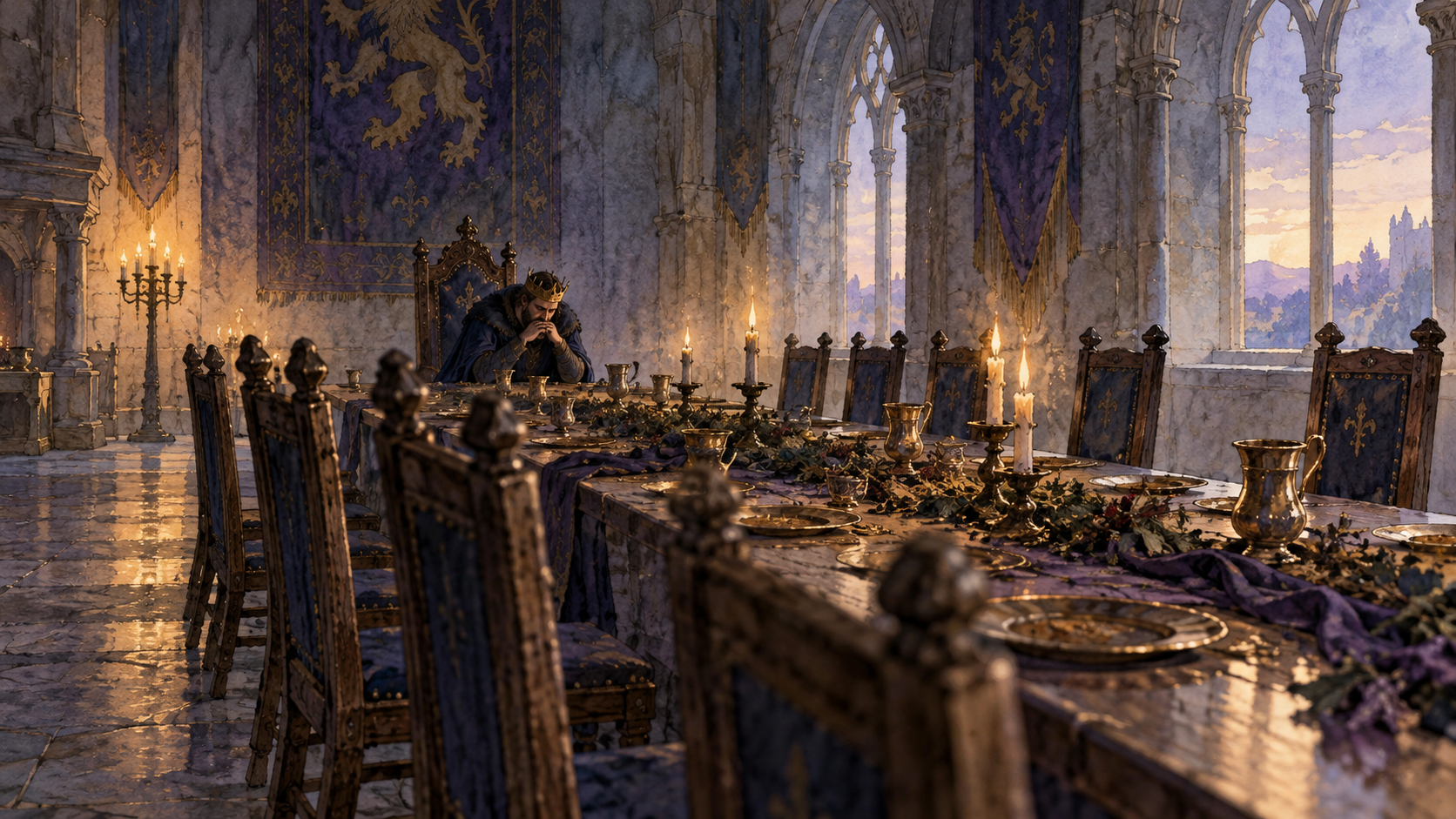
Act 4: thought moves rapidly into violent action
Macbeth returns to the witches for reassurance. Their apparitions warn him about Macduff while offering promises he interprets as protection. When he learns that Macduff has fled to England, he resolves to attack Macduff’s castle and kill his family.
“The very firstlings of my heart shall be
The firstlings of my hand.”
In Act 4, Scene 1, “firstlings” connects the earliest impulses of his heart with immediate action by his hand. Compare the extensive deliberation before Duncan’s murder. Macbeth now announces a determination to close the interval in which reflection could restrain him.
The attack on a wife and children extends his violence to people outside the immediate struggle for the throne. His decision gives the term “tyrant” concrete substance. For an essay, identify what he orders and what that reveals about the authority he has created.
Tracing those decisions scene by scene also helps you connect a character claim to the exact passage supporting it. Our Macbeth course includes explanations and writing challenges for developing that kind of interpretation.
Act 5: exhaustion, disillusionment and a final fight
Macbeth describes himself as having “almost forgot the taste of fears” in Act 5, Scene 5. The sensory image suggests familiarity with horror has dulled his response. “Almost” leaves a small but revealing qualification: his claim to emotional hardness is incomplete.
News of Lady Macbeth’s death leads into “Tomorrow and tomorrow and tomorrow”. Repeated days seem to crawl towards death. Earlier, the future offered a crown worth pursuing; now time appears emptied of meaningful achievement. The speech can hold grief and weariness together.
Macduff’s account of his birth finally overturns Macbeth’s confidence in the witches’ promise. Macbeth initially refuses further combat, then chooses to fight when threatened with capture and humiliation in Act 5, Scene 8. His refusal to surrender preserves something of his earlier martial courage. It offers no repair for the suffering caused by his rule.
Macbeth’s character arc: decisions across five acts
Read the sequence as changing choices. Fear and courage recur within it.
Act 1 · Honour and temptation
Defends Duncan, imagines kingship, debates murder and accepts the plan.
Change: loyal service gives way to concealed ambition.
Act 2 · A crossed boundary
Kills Duncan and recoils from the deed.
Change: ambition has become action; guilt disrupts him.
Act 3 · Power under threat
Orders Banquo’s murder and conceals the details from his wife.
Change: securing his position drives independent violence.
Act 4 · Tyranny accelerates
Seeks reassurance and orders the attack on Macduff’s family.
Change: impulse becomes a policy of immediate action.
Act 5 · Meaning drains away
Faces loss, the collapse of prophetic reassurance and defeat.
Change: exhausted defiance survives his failing power.
Use the timeline to build a developing argument
A useful paragraph explains a relationship between moments. Try this original teaching example:
Shakespeare shows Macbeth becoming increasingly willing to turn desire into violence. His early recognition of “Vaulting ambition” reveals an ability to examine his motives. By Act 4, the “firstlings” of his heart are to become the actions of his hand. That movement from deliberation to immediacy suggests that he increasingly suppresses the reflection that once delayed him.
The paragraph selects two moments, analyses their language and connects them through a claim about change. Use your own wording and follow your assignment’s requirements. Add another scene if it complicates your argument: the banquet, for example, shows that his fear survives his growing ruthlessness.
For a whole essay, organise your sections around stages in that development. Establish his honoured position, examine the decision to kill Duncan, then consider what he does with the power he gains. Give the ending space to complicate the earlier pattern. Each section should advance your answer to the question, with quotations chosen because their language supports that advance.
Watch the verbs in your analysis. “Considers”, “refuses”, “accepts”, “orders” and “conceals” describe particular actions you can locate in a scene. Pair those verbs with precise interpretations. Calling Macbeth ambitious throughout leaves the reader wondering how that ambition changes his behaviour; tracing the decisions supplies the explanation.
For practice, compare Macbeth’s response after Duncan’s murder with his response to the cry of women in Act 5. Choose one short quotation from each scene. Explain what changes in his reaction, then consider what the word “almost” prevents you from claiming.
A strong reading of Macbeth follows the choices that reshape him and the qualities that persist. If you want to develop that reading across the whole play, our Macbeth course pairs scene explanations with opportunities to practise your own analysis.