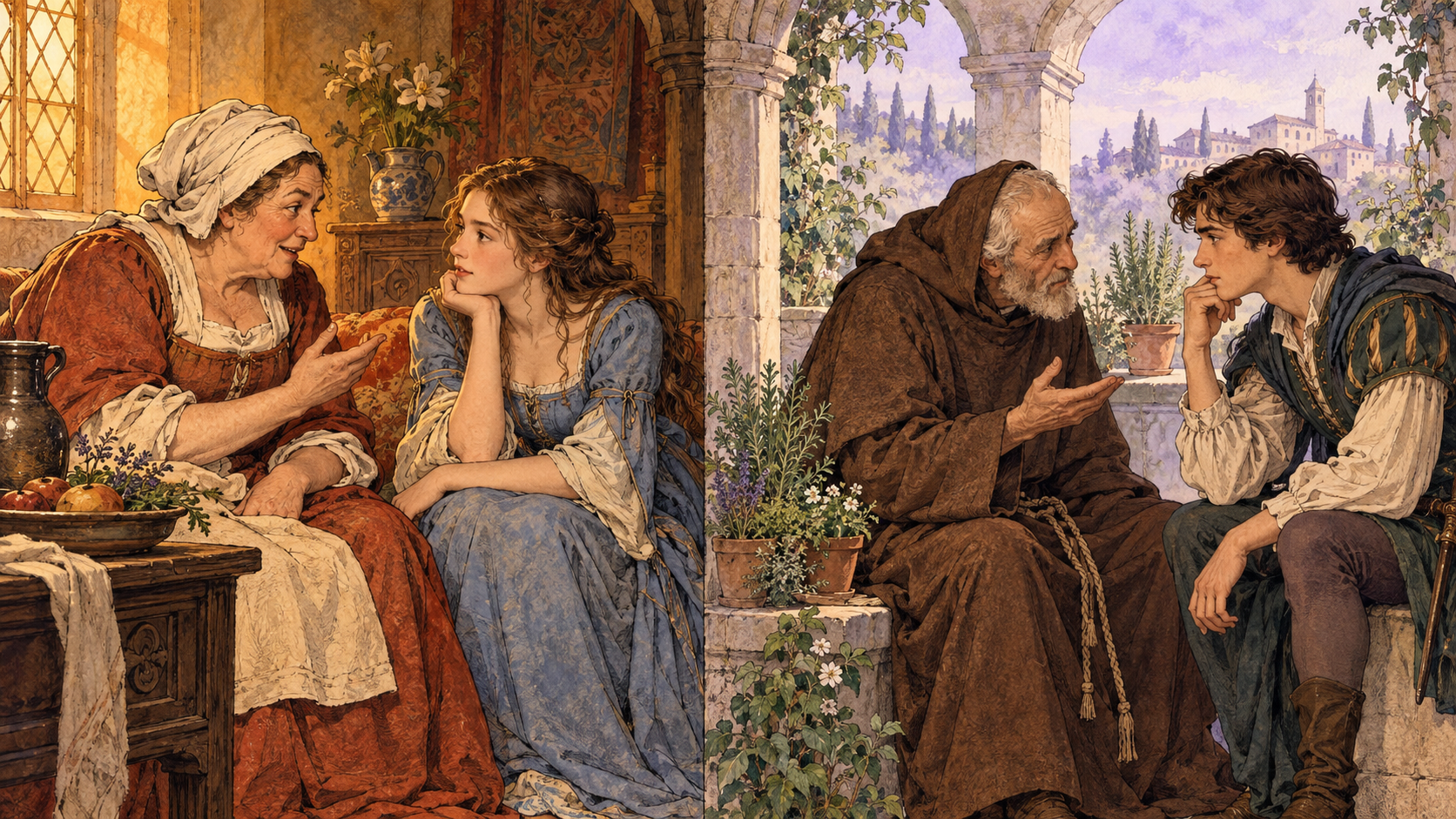
Beatrice and Benedick seem able to turn any greeting into a contest. In Much Ado About Nothing, their quick replies reveal how closely they attend to each other, while giving both a way to avoid admitting affection. A useful Beatrice and Benedick relationship analysis follows that tension from public wit to the difficult choices that intimacy demands.
For your essay, begin with a small verbal move: a repeated word, an insult returned or a sudden change of pace. Explain what it lets each speaker do. Then connect that moment to the relationship’s development. The plot supplies the circumstances; the language supplies your evidence.
What makes their conflict a “merry war”?
Leonato’s description of their “merry war” in Act 1, Scene 1 combines pleasure with combat. Each encounter offers an audience for their cleverness. Their familiarity also gives the jokes a personal edge: Beatrice’s closing observation, “I know you of old”, suggests a shared history without providing a complete account of it.
Notice how an insult becomes shared material. Benedick addresses her as “Lady Disdain”; she takes up his personification and imagines disdain feeding on him. He tries to define her, and she immediately revises the definition. Neither comfortably controls the conversation.
Her phrase “meet food” adds a pun: “meet” means suitable and sounds like “meat”. Benedick becomes an appropriate meal for the disdain he complains about. Naming the pun is your starting point. Explaining how it turns his accusation into evidence against him gives the observation a purpose in your argument.
Calling this flirtation is a defensible interpretation, provided you explain the mixture of attraction and hostility. A performer could make the same reply sound delighted, wounded or impatient. Your argument should leave room for the sharpness of their words. Mutual attention can coexist with the wish to protect oneself.
Dialogue Deconstruction: follow the borrowed insult
Read this short exchange aloud. Shakespeare gives each speaker an animal image to work with:
Benedick: “Well, you are a rare parrot-teacher.”
Beatrice: “A bird of my tongue is better than a beast of yours.”
These are Beatrice and Benedick’s words in Act 1, Scene 1. Benedick’s “parrot-teacher” reduces her verbal skill to chatter. Beatrice accepts the bird image and redirects the comparison towards him. Her balanced “my” and “yours” gives the reply the shape of a contest, while “beast” makes his supposed superiority look brutish.
The word “tongue” connects speech with the body producing it. Her answer defends both her voice and her right to answer him. Describe this as a rapid exchange in prose. Stichomythia strictly describes alternating single lines of verse; applying it automatically to this prose passage would blur the form you are analysing.
For your own deconstruction, underline the borrowed image, circle the changed comparison and write one sentence about who gains ground. Then try two readings aloud: amused and irritated. Identify the word whose emphasis changes the relationship most. This gives you a precise performance possibility to discuss.
An insult changes hands
Benedick: “parrot-teacher”
Move: turn her eloquence into chatter.
Beatrice: “bird” / “beast”
Countermove: keep his image, reverse its ranking.
Follow the changing stakes
- 1.1: Public contest. Each returns the other’s language.
- 2.3 and 3.1: Overheard affection. Staged conversations make reciprocation seem possible.
- 4.1: A costly demand. Hero’s treatment tests Benedick’s allegiance.
- 5.4: Affection exposed. Their poems reveal what public teasing conceals.
How wit protects them from vulnerability
Both characters make resistance to romance part of their public identity. A joke allows a speaker to approach an uncomfortable subject while retaining an escape route: everything can still be treated as entertainment. That reading helps explain their defensive brilliance, although the text leaves their private motives open to interpretation.
The masked dance in Act 2, Scene 1 shows how painful this entertainment can become. Beatrice calls Benedick the Prince’s jester while speaking to him in disguise. His subsequent indignation exposes how strongly her judgement affects him. The insult lands because her opinion carries weight.
If you are practising dialogue in your own fiction, our worked guide to purposeful fictional replies explores how each response can alter a scene. Here, Shakespeare makes verbal competition reveal a connection the characters keep publicly resisting.

How do Beatrice and Benedick fall in love?
The gulling scenes give each character apparent evidence of the other’s affection. In Act 2, Scene 3, Don Pedro, Claudio and Leonato stage a conversation for Benedick to overhear. Hero and Ursula perform a parallel deception for Beatrice in Act 3, Scene 1. The audience knows the speeches are arranged, creating dramatic irony.
The trick offers each a safer reason to change. Benedick can imagine himself generously returning love; Beatrice hears criticism of her pride and resolves to respond differently. Their decisions suggest that social pressure and the promise of acceptance help loosen their defensive identities.
Watch Benedick interpret Beatrice’s dinner invitation after his friends’ performance. He announces a “double meaning” in her reluctant message. The comedy comes partly from his eagerness to find affection in ordinary words. Distinguish a character’s hopeful interpretation from a meaning the play proves she intended.
To strengthen this kind of close reading, practise explaining how a single word changes the reader’s understanding. Our Much Ado About Nothing course offers scene-by-scene study and writing challenges with personalised feedback.
Why “Kill Claudio” changes the conversation
After Claudio publicly humiliates Hero in Act 4, Scene 1, Beatrice and Benedick acknowledge their love. His offer to do anything for her receives the abrupt answer “Kill Claudio.” The short imperative changes the stakes of their exchange. Beatrice demands action against his friend.
Benedick initially refuses, then listens and agrees to challenge Claudio. Beatrice’s anger connects her cousin’s injury with women’s restricted access to the masculine honour code. Her wish to be a man expresses frustration at that restriction. The demand also carries a disturbing commitment to violence; a nuanced essay can acknowledge its force and its danger.
Here, equality becomes a question of whose judgement receives serious attention. Benedick accepts that Beatrice’s account of Hero’s treatment requires a response. Their emerging partnership acquires a cost beyond being clever together.
Paragraph task: argue for a qualified equality
Write 120–160 words answering: How does Shakespeare present Beatrice and Benedick as verbal and romantic equals? Use the animal-image exchange, then connect it to one later scene. Explain a specific language choice and qualify your interpretation. Here is one possible original model:
Shakespeare gives Beatrice and Benedick a verbal equality built through their ability to answer each other. When Benedick calls her a “parrot-teacher”, Beatrice takes possession of his animal imagery, placing her “bird” above his “beast”. The balanced pronouns turn his attempted dismissal into a comparison he loses. Their quick responsiveness suggests the attention that can sustain attraction, although the insults also allow both to conceal vulnerability. In Act 4, Scene 1, Beatrice’s demand that Benedick challenge his friend tests whether this verbal parity can become a partnership. His agreement gives her judgement practical weight within a society that restricts her own capacity to seek redress. Their equality therefore develops through a difficult choice, while remaining constrained by the gendered honour system around them.
The model moves from a small textual detail to a larger claim, then introduces a qualification. Check your paragraph for that movement. In Act 5, Scene 4, the exposed love poems let both retain some teasing dignity while revealing reciprocal feeling. Their wit survives their decision to marry.
Before finishing, check that your quotation belongs to the scene you name. Replace a broad claim such as “they are always equal” with the particular kind of equality your evidence supports. Verbal confidence, freedom to act and emotional openness develop unevenly. You can argue that their responsiveness makes them well matched while recognising that Beatrice must ask Benedick to undertake the challenge she wants.
Try the same method with a fresh exchange: follow one word through the replies and explain how its meaning shifts. Our Much Ado About Nothing course lets you follow the play scene by scene and develop your ideas through writing challenges.