Macbeth historical context becomes useful in an essay when it helps you explain a particular word, image or dramatic choice. James I’s interest in witchcraft, the insecurity surrounding royal succession and the Gunpowder Plot can sharpen a reading of the play. Choose a relevant detail, connect it to a passage, then show what that connection adds to your argument.
A paragraph can contain several accurate dates and still leave Shakespeare’s language untouched. Give context a job: explain why a king’s murder carries religious weight, why a prophecy about descendants has political resonance, or why a joke about deception lands beside a hidden crime.
Keep the story’s period and Shakespeare’s period separate
The action takes place in medieval Scotland. The play belongs to the early years of James I’s English reign, the Jacobean period. James was already James VI of Scotland when he inherited the English throne in 1603. Those two historical settings need separate labels in your notes.
Macbeth is commonly dated around 1606, although its exact composition date is uncertain. Shakespeare drew on Holinshed’s Chronicles and reshaped his material for drama. Treat the play as an imaginative work, with a later audience’s concerns running through its representation of Scotland.
Before using a contextual fact, ask two questions: which moment does it illuminate, and what becomes clearer when I include it? A date earns its place through the answer. Your essay can spend most of its energy examining what happens on the page and stage.
Kingship: listen to the religious language
James defended the divine right of kings, the idea that royal authority derived from God. This gives a useful frame for Macduff’s discovery of Duncan’s body in Act 2, Scene 3. He calls the murder “sacrilegious” and Duncan’s body “The Lord’s anointed temple”.
“Sacrilegious” places the crime within a religious vocabulary. “Temple” imagines the king’s body as a sacred building that has been broken open. You can connect those choices to a culture in which kingship carried claims of divine authority, then explain how they enlarge the consequences of Duncan’s death.
Keep the argument precise. Macduff speaks these words; the whole play also examines the suffering caused by Macbeth’s rule and the resistance to it. That later action complicates any account of royal power as automatically deserving obedience. Context supplies a tension you can explore, especially when an essay asks about legitimate kingship.
Witchcraft: connect belief to the problem of trust
James published Daemonologie in 1597, before becoming king of England. It discusses witchcraft and demonic activity. His interest provides a documented connection between the play’s supernatural encounters and the concerns of its royal patron, who supported Shakespeare’s company, the King’s Men.
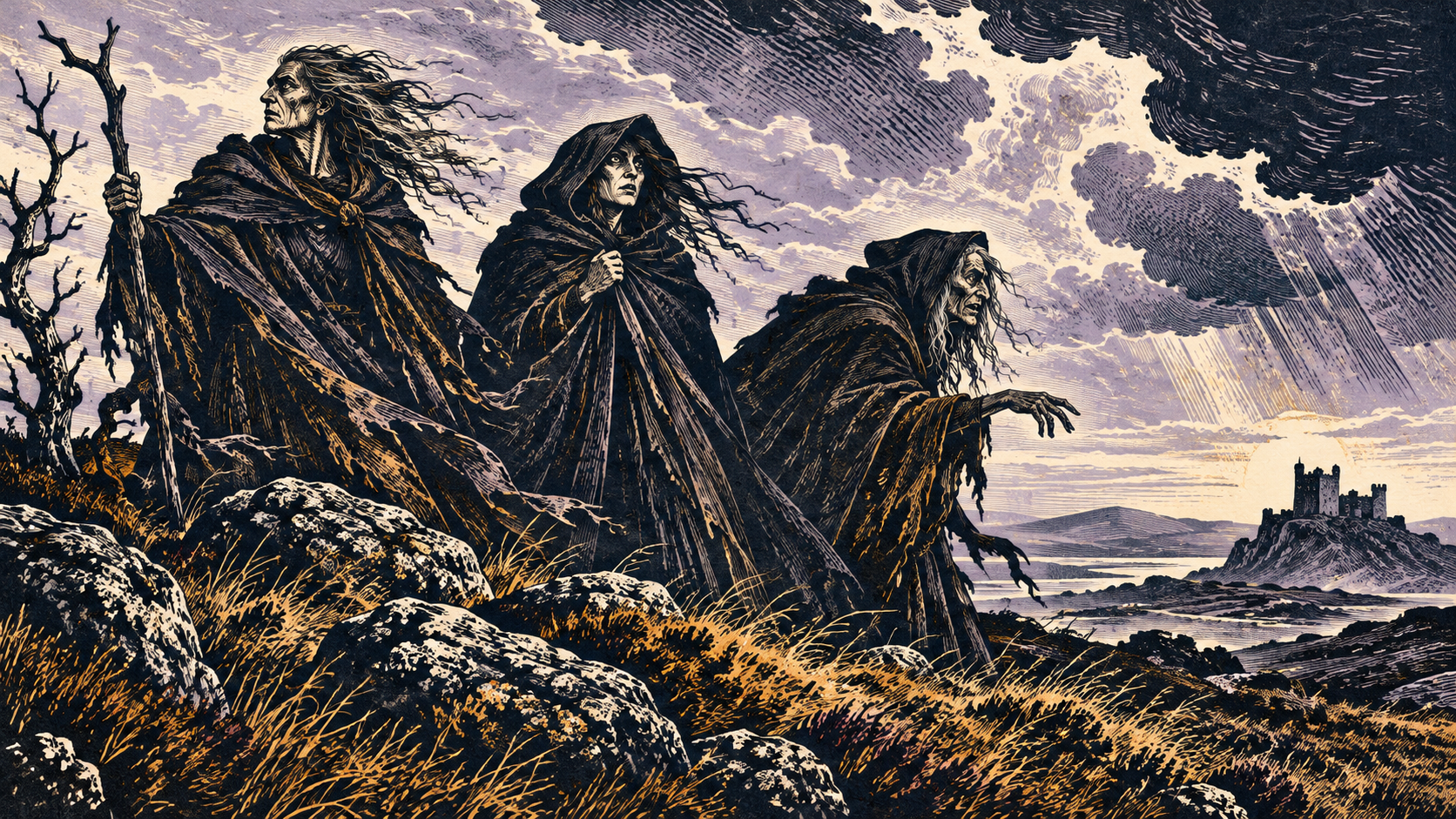
In Act 1, Scene 3, Banquo warns that dangerous supernatural agents may offer small truths that lead towards harm. The warning helps you examine how Macbeth treats an apparently fulfilled prediction as grounds for trusting the larger promise. Focus on the movement from evidence to confidence.
An effective essay might argue that contemporary concern about witchcraft intensifies the uncertainty surrounding the witches’ advice. It should also follow Macbeth’s response. He imagines murder and later acts upon his ambition; his decisions remain available for scrutiny. Avoid claiming that every Jacobean spectator shared one belief or that the witches remove his responsibility.
For a closer look at the passages themselves, see our analysis of the supernatural in Macbeth. That reading can help you choose a brief piece of textual evidence for your contextual argument.

The Gunpowder Plot: use the echo carefully
The Gunpowder Plot of 1605 was an attempt to kill James and others by blowing up Parliament. Its discovery made treason an urgent public concern. The Porter’s reference to an “equivocator” in Act 2, Scene 3 is often linked to the controversy over equivocation surrounding the plot and its aftermath.
Equivocation involves language that can conceal meaning or work in different senses. In this scene, the Porter imagines admitting sinners through the gates of hell while Duncan’s murder waits to be discovered inside the castle. The comic interruption briefly changes the pace and keeps moral judgement close to the concealed crime.
You can explore the possible topical echo while analysing that dramatic placement. Phrase the historical connection as a plausible resonance. The passage supports an argument about treason and deceptive language without requiring certainty about a single target for the joke. Check the edition and notes you are using before making a specific identification.
If you would like guided practice connecting a scene’s language to an interpretation, explore the Macbeth course’s scene explanations and writing challenges.
Succession: ask whose future the crown promises
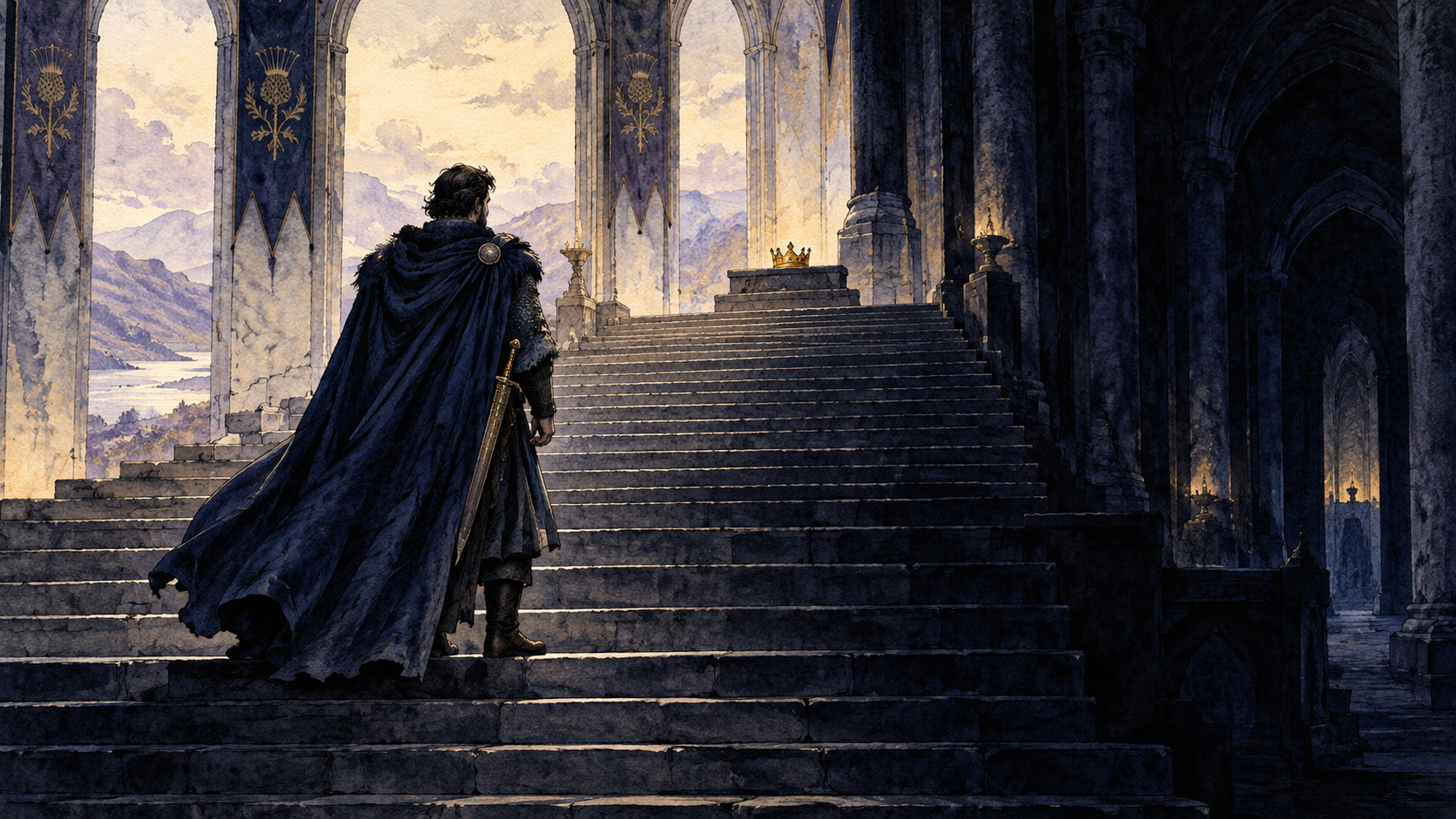
James traced his ancestry to Banquo. In Act 4, Scene 1, the witches show Macbeth a procession of kings associated with Banquo’s line. For a courtly audience, that sequence could carry a flattering connection to the reigning monarch’s claimed ancestry.
For Macbeth, the same spectacle exposes the limits of his achievement. He has obtained the crown, yet the future appears to belong to another family. An essay about insecurity can use the historical association to explain the scene’s double perspective: reassurance for a dynasty alongside distress for the character watching it.
Keep James’s claimed descent distinct from a verified family tree. Also resist treating the scene solely as a compliment. Its immediate dramatic work is to confront Macbeth with a future he struggles to control.
Give context a route into the text
Start with a historical connection. Finish with a claim about the scene.
Royal authority
Divine right → Act 2, Scene 3 → the temple image makes Duncan’s murder a sacred violation.
Supernatural danger
James’s witchcraft interest → Act 1, Scene 3 → Banquo’s warning raises questions about trusting a partial truth.
Treason and deception
The plot’s aftermath → Act 2, Scene 3 → the Porter’s joke gives concealed murder a possible topical echo.
A dynasty’s future
James’s claimed ancestry → Act 4, Scene 1 → Banquo’s royal line unsettles Macbeth’s grip on succession.
Practise a connection that earns its place
Try a short paragraph about Duncan’s murder. Begin with your interpretation of the temple image, explain one word, then connect that reading to divine kingship. Return to the scene’s consequences in your final sentence. Use your own phrasing and follow your assignment’s referencing requirements.
Here is an original model showing that movement:
Macduff’s description of Duncan’s body as a temple gives the murder a religious dimension. The building metaphor presents a protected, sacred space that violence has invaded. James’s defence of divine kingship helps explain the force of that description: an attack upon a king could be understood as an offence against an authority sanctioned by God. In the scene, Macduff’s response turns the discovery into a public alarm, extending the significance of the crime beyond Macbeth’s private ambition.
The model begins with an interpretation and spends its contextual sentence explaining the metaphor’s force. Its closing sentence returns to dramatic action. You could develop it further by examining Macduff’s urgent commands, or by comparing this response with Macbeth’s later treatment of his subjects. Choose the next step according to the question you have been set.
Read your draft with the historical sentence temporarily covered. If the remaining sentences contain a clear textual argument, you have something for context to strengthen. Then uncover it and check that it explains the passage’s significance. Revise any sentence that simply announces what people supposedly believed.
The Macbeth course offers space to develop these connections across the play. Follow the scenes, test your interpretations in writing challenges and use personalised feedback to explore how your evidence supports your claim.