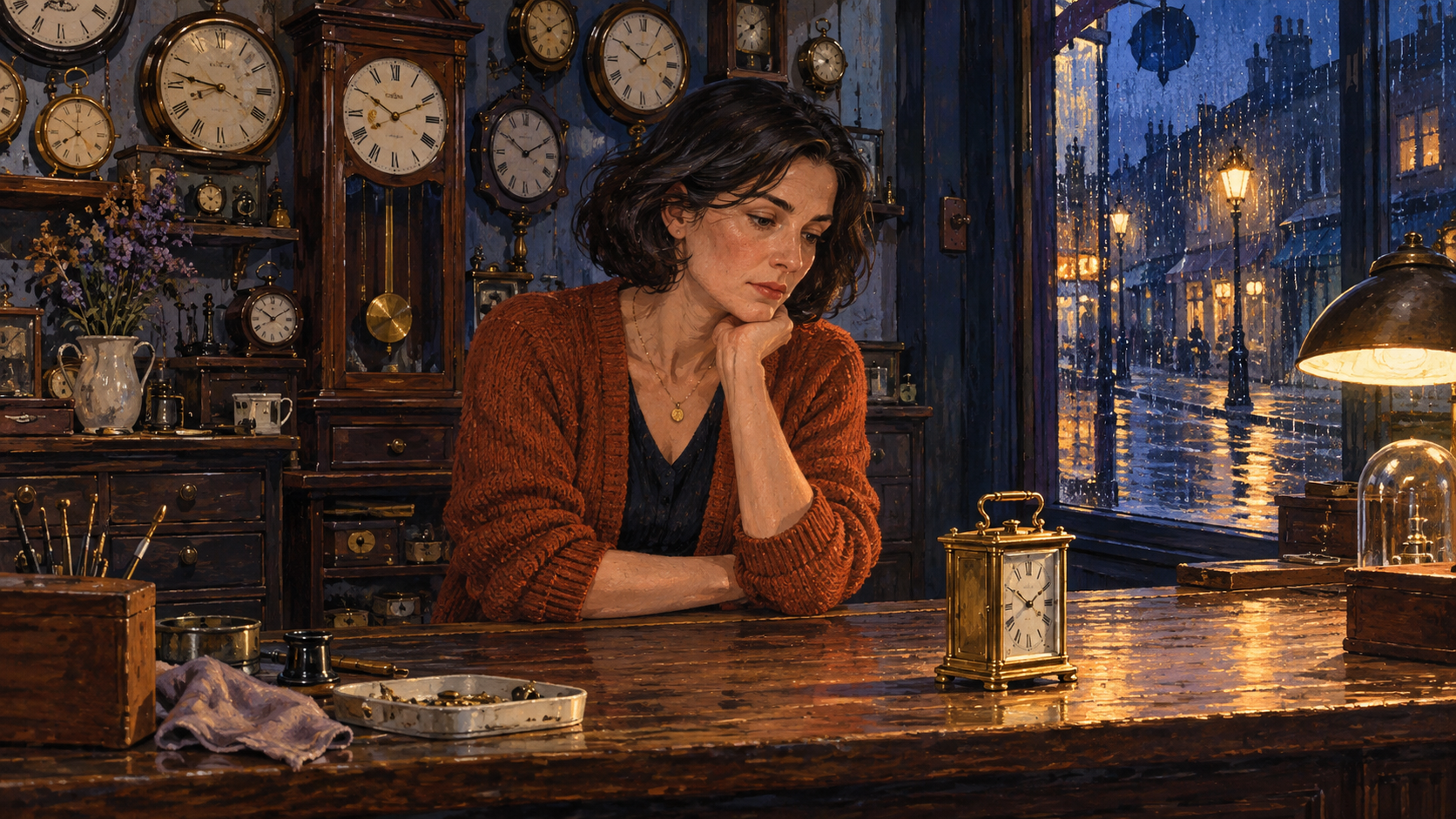
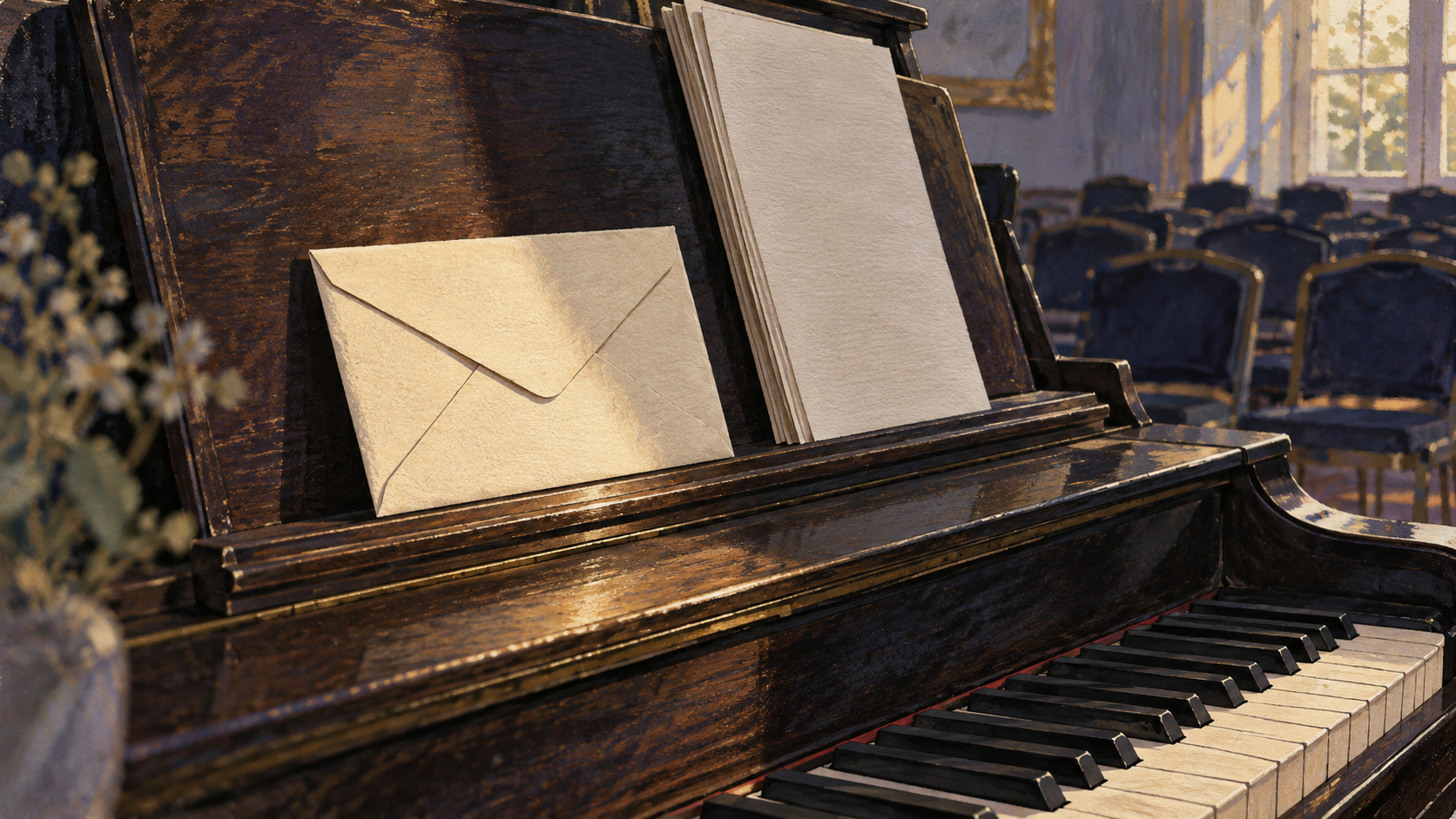
Noor is about to play a piano recital. Her mother's chair is empty, and an unopened letter waits on the music stand. You can describe the chair and envelope from outside. To let the reader feel Noor's disappointment, you need access to the interpretation she keeps to herself.
To write internal monologue in third person, establish whose experience guides the scene, then choose how to present the thought: directly in the character's own words, indirectly through a narrator's report, or through free indirect discourse, where the character's voice colours the narration. These choices can work together. The original examples below show what changes when you rewrite the same moment.
Contents
Anchor the thought in one character
Our scene uses third-person limited narration. We follow Noor's experience, using her name and pronouns such as she and her. We can enter her thoughts while seeing other people through what she observes or understands.
Noor set her mother's envelope on the piano's music stand. The front-row seat she had saved was empty. In five minutes she would have to begin.
This opening supplies a location, a person and an immediate pressure. Noor can see the empty chair. She knows whom she saved it for. She also recognises the envelope as her mother's. The reader has enough context to understand whose response follows.
Keep the limits of her knowledge intact. Noor can suspect that her mother has sent criticism, but the unopened envelope gives her no evidence of its contents. A sentence announcing her mother's private intention would change the access established here. For a worked example of that problem, read our guide to avoiding head-hopping in third-person fiction.
Write a direct thought in the character's own words
Direct thought presents the words you imagine Noor thinking at this instant:
Noor set her mother's envelope on the piano's music stand. The front-row seat she had saved was empty. I asked her to come today. Of course she sends a letter instead. In five minutes she would have to begin.
The narration remains third person and past tense. Inside the thought, Noor calls herself I, calls her mother she, and uses the immediate today. Asked refers to her earlier invitation; sends gives her present reaction. Direct thoughts can contain any tense the imagined thought needs.
Italics distinguish these words in this example. They are a house-style choice. You could also introduce an unitalicised direct thought with a tag:
Noor thought, I asked her to come today. Of course she sends a letter instead.
Choose a consistent treatment that makes the transition clear. Quotation marks are another available convention, although reserving them for spoken dialogue can help readers tell speech and thought apart. No single typographic treatment is compulsory.
A direct thought can suit a sharp reaction or a phrase the character repeats inwardly. Here, Of course gives Noor's disappointment a familiar edge: she feels this has happened before. That implication comes from her wording, and the story can later confirm or complicate it.
Report an indirect thought through the narrator
An indirect thought reports the idea through a sentence organised by the narrator:
Noor set her mother's envelope on the piano's music stand. The front-row seat she had saved was empty. She thought that she had asked her mother to come that day, yet her mother had sent a letter instead. In five minutes she would have to begin.
The phrase She thought that identifies the mental activity. I asked becomes she had asked, and today becomes that day in this version. Her complaint is folded into the narrator's reporting sentence. The words tell us what Noor believes without presenting an exact inner utterance.
You can compress the report further: “Noor resented receiving a letter when she had hoped to see her mother.” That summary moves quickly over the reaction. It may suit a passage where her next decision deserves the space. The longer version lets the reader follow her reasoning.
Thought tags can provide useful orientation. Check what each one contributes in context. A scene crowded with she thought, she wondered and she realised may benefit from varied treatment, while a single tag can make an otherwise ambiguous sentence clear.
Let the character's voice enter the narration
Free indirect discourse brings Noor's phrasing into third-person narration without a reporting clause:
Noor set her mother's envelope on the piano's music stand. The front-row seat she had saved was empty. She had asked her mother to come today. Of course there had to be a letter instead. In five minutes she would have to begin.
The sentences keep the past-tense frame and refer to Noor as she. Yet today belongs to the time she is living through, and Of course there had to be carries her irritated judgement. The narration takes on her accent of thought.
Context does much of the work. We have just seen Noor register the chair and envelope, so her complaint follows naturally. Removing a thought tag alone does not guarantee free indirect discourse. A sentence such as “The hall contained thirty chairs” may simply report a fact; a character's distinctive evaluation or question helps create the effect.
Try reading the complaint aloud in Noor's voice. Does it sound like something this person would think under this pressure? A more hopeful Noor might think, “Perhaps the letter explained everything.” A more suspicious Noor might think, “A letter, five minutes before she played. Excellent timing.” Those alternatives change her attitude and therefore the scene.
Compare pronouns, tense and the character's voice
These excerpts focus on the same disappointment. The grammatical differences show how each version positions the reader.
| Form | Excerpt | What to notice |
|---|---|---|
| Direct | I asked her to come today. Of course she sends a letter instead. | I is Noor; she is her mother. Past invitation, present reaction. Noor's imagined wording is given directly. |
| Indirect | She thought that she had asked her mother to come that day, yet her mother had sent a letter instead. | She is Noor. Past-perfect verbs fit the report. That day shifts the time expression into reported form. |
| Free indirect | She had asked her mother to come today. Of course there had to be a letter instead. | Third person and past tense remain. Today and the complaint's rhythm bring in Noor's perspective without a thought tag. |
This table describes our past-tense scene. A present-tense story will handle tense differently. Use the categories to understand a passage's effect; real fiction can move fluidly between them, with stretches whose boundaries are less clear.
If you would like guided practice in shaping a character's voice and revising a scene, WriteCraft Pro includes creative writing exercises and personalised constructive feedback.
Choose a treatment for the moment
Start with the effect you want. The following diagram offers three routes from a scene's immediate need. You can try several before choosing.
How close do you want this thought to sound?
Begin with the scene
Noor sees the empty chair. The letter is still closed.
Hear the inner words
Try direct thought.
Give a particular phrase room to strike. Choose clear, consistent formatting.
Carry the idea quickly
Try indirect thought.
Report or summarise the response, then move towards the next event.
Colour the narrative voice
Try free indirect thought.
Let the character's phrasing enter the narration while keeping the viewpoint legible.
Read back in context: whose response is this, and what does it add to this moment?
Combine thought with the unfolding scene
A thought can alter what the character does next. Noor's assumption about the letter might make her postpone opening it, leaving the reader to wonder whether she has judged it fairly.
Noor set her mother's envelope on the music stand. The saved chair was empty. Of course there had to be a letter instead. She slid it behind the blank rehearsal paper. A door clicked at the back of the hall, and she turned.
Her interpretation leads to a choice, then an outside sound interrupts it. We stay with her throughout. The door might bring her mother, another performer or the caretaker; Noor has to look before she knows.

You can also allow a thought to linger. If Noor's memories are the scene's purpose, a sustained passage may deserve space. Read for the balance you want between inward reflection and events in the room. A concert can wait on the page while a single remembered sentence takes hold.
Check pronouns where two women share a paragraph. Repeating her mother can be useful when she has become ambiguous. Clear reference gives the reader room to attend to the emotion.
Try a convert-the-passage exercise
Rewrite this direct thought as an indirect report, then as free indirect discourse. Keep Noor as the viewpoint character:
Noor heard the door click. I can't look yet. If it's her, I'll forget the opening. She placed her fingers on the keys.
One indirect version: Noor heard the door click. She thought that she could not look yet because she would forget the opening if her mother had arrived. She placed her fingers on the keys.
One free indirect version: Noor heard the door click. She couldn't look yet. If her mother had arrived, the opening would vanish from her mind. She placed her fingers on the keys.
The report makes the reasoning explicit. The free indirect version keeps the urgency of her refusal and prediction within past-tense narration. Both clarify whom her means. Neither confirms that her mother has arrived: Noor is responding to a possibility.
Now try the same conversions with a moment from your draft. Read the surrounding paragraph too, checking voice, pronouns and what the character can know. Keep the version that gives this scene the pace and intimacy you want.
Rewriting a thought is a small change that can reshape a whole encounter. WriteCraft Pro offers further scene-writing and revision practice, with optional exercises and personalised feedback, so you can keep exploring how a character's private response reaches the page.