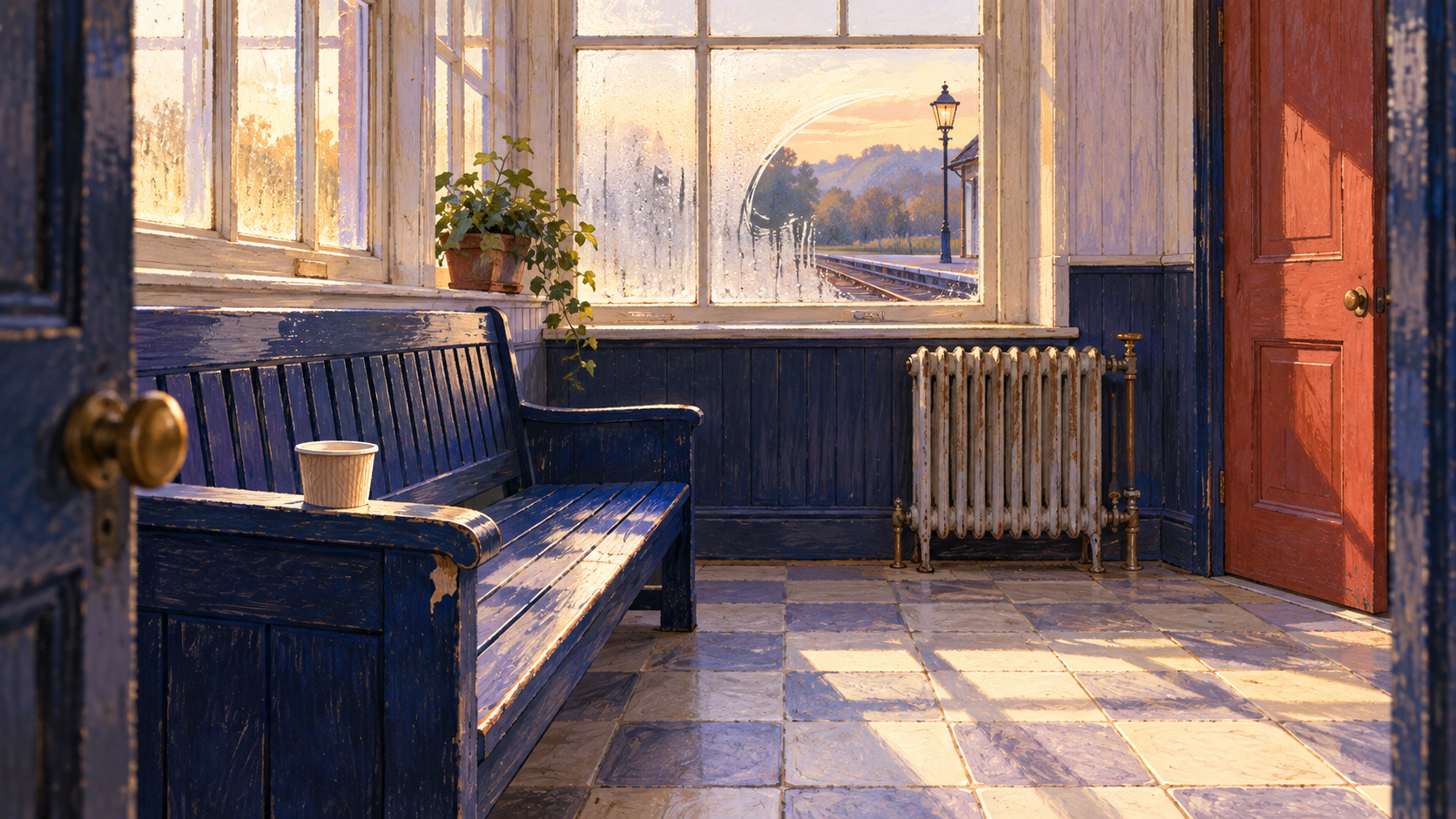
A waiting room can be ‘old and gloomy’, or it can have a crescent of bare wood on the bench where hundreds of sleeves have rubbed away the paint. The second version gives your reader something to picture. Good description begins with attention, followed by decisions about which details deserve space.
These descriptive writing exercises for adults take you from a small observation to a short scene. Each has an original worked response and a self-check. You can follow the sequence with one setting or use a different subject each time. Keep your first attempts: the differences between versions will show you what your choices achieve.
Contents
Start with a manageable subject
Choose a place or object you can examine comfortably: a kitchen shelf, a bus shelter, a coat hanging by the door. A photograph can supply visual detail; an imagined setting lets you practise invention. Keep clear which you are using. If you are working from a photograph, any sound or smell you add is a creative choice.
For the worked responses, we will use a fictional railway waiting room. Its bench, window and paper cup give us a modest pool of material. You need very little equipment: somewhere to keep notes and enough time to look again. The word limits below are practice constraints; adjust them when your subject needs a different pace.
1. Record what is actually there
Your task: collect six observations about one subject. Write plain notes before making sentences. Replace a broad judgement such as ‘messy’ with an observable detail that led you to it. If you choose a real place, stay with what you can perceive. For an invented setting, establish details you can keep consistent.
Worked response: navy bench; paint worn through on the outer arm; paper cup with a brown ring inside; window clouded at the edges; curved clear patch on the glass; radiator beneath the window.
These notes give us usable material without settling the mood. The worn paint could suggest neglect, familiarity or years of ordinary use. We have left that decision open. The cup's ring is a detail a reader can picture; calling the whole room depressing would ask them to accept a judgement before seeing it.
Self-check: underline each concrete object or feature. Circle judgements such as ‘lovely’, ‘strange’ or ‘unpleasant’, then add the evidence behind them. Keep a judgement when it belongs to the voice you eventually choose. At this stage, the notes should give you something specific to work with.
2. Choose a revealing detail
Your task: select two observations from your notes and write 35–50 words that suggest a place has been used. Give the reader a clear impression while leaving room for interpretation. Invent a plausible connection if needed, but avoid presenting a guessed history as a fact about a real location.
The bench's outer arm had lost a crescent of navy paint. Whoever sat there could rest a sleeve on bare wood, warm and smooth, while the rest of the bench kept its glossy navy coat.
The response develops one small contrast within the object. The worn patch and smooth surface suggest repeated contact. We have no need to supply a catalogue of passengers or announce how many years the bench has stood there. A different writer might choose the cup to suggest a recent interruption.
Self-check: ask what your chosen detail suggests and which words support that reading. If every detail points towards a different mood, choose the impression you want and strengthen its evidence. You can keep an unexpected detail when it makes the place feel particular.

3. Select sensory detail
Your task: write 45–65 words about the same setting using two senses that help establish a particular experience. Choose details a person in that position could perceive. You might hear rain on a roof or feel the cold through a metal chair. Use the senses available to your narrator and your setting.
The radiator clicked beneath the window, then fell quiet for a moment. Ella cupped her hands around the paper cup. Its thin rim had softened where she had pressed it with her thumb; the tea still warmed her palms, although the room's draught reached her ankles.
Sound and touch make this waiting room feel unevenly warm. The softened rim also gives Ella something small to do. Sensory choices can be economical: a single recurring sound may carry a passage. Taste earns its space when someone eats or drinks; an unused sense can wait for another scene.
Self-check: identify what each sensation contributes. Does it establish temperature, distance, discomfort or familiarity? Remove a sensation that merely repeats an impression already clear. Read the paragraph again to check that the remaining details still place the reader in the room.
Practising the same setting in several versions makes it easier to notice how each choice changes the reading experience. WriteCraft Pro includes creative-writing exercises and personalised constructive feedback that can help you examine those decisions.
4. Change the viewpoint
Your task: describe the waiting room twice, in 25–40 words each. First, use a passenger hoping to catch a connection. Then use a cleaner arriving at the end of a shift. Keep the physical room consistent while changing what each person attends to. Viewpoint means the position and awareness through which we experience the scene.
Passenger:
Through the clear patch in the window, Ella could see the platform entrance. She kept the cup between her knees, leaving both hands free to lift her bag when the doors opened.
Cleaner:
Ravi set his bucket beside the radiator. The cup on the bench would go first. Then he could wipe the window, starting with the curved mark someone had already cleared through the condensation.
The passenger looks for movement outside. The cleaner sees a sequence of jobs. Both can notice the cup and window; their purposes determine how those objects enter the prose. This can distinguish viewpoints without giving each person a different set of eyes or changing the furniture between versions.
Self-check: name what each person wants at this moment. Check whether the selected details support that concern. Keep knowledge within reach: Ella can see the entrance, but she cannot know what Ravi will think later. If you include another person's thoughts, make the change in viewpoint deliberate.
5. Find precise words
Your task: write a plain sentence about one object, then revise it using a more exact noun, verb or physical detail. Keep useful adjectives. Test a comparison only if it helps the reader picture the thing. Aim for two or three sentences in your final version.

First attempt: ‘The window was very wet and looked strange.’
Condensation clouded the window. A curved wipe mark exposed a strip of platform, and a bead of water travelled down its edge.
‘Condensation’ identifies the moisture. ‘Clouded’ gives it a visible effect, while the wipe mark creates a shape. The moving bead makes the detail easy to follow. You could add a comparison, but the picture is already clear. Saving an image for the sentence that needs it can give that image greater force.
Self-check: point to the work done by each descriptive word. If you wrote ‘beautifully shimmering silver droplets’, try ‘droplets’ with one precise verb and compare the effect. Retain wording that suits your voice. Precision can be quiet; a room does not need to sparkle in every sentence.
6. Build a short scene
Your task: use your notes to write 80–110 words around a small moment. Choose one viewpoint and a simple purpose, such as waiting for someone or preparing to leave. Select a few details, arrange them in an intelligible order and finish with a small change. Keep the focus on description and attention.
Ella took the end of the bench nearest the window. The bare patch on its arm fitted beneath her palm, smooth against the rough cuff of her coat. She watched the platform entrance through a curved gap in the condensation. Under the sill, the radiator clicked twice. Her connection was due soon, and she had already folded the ticket along a deep crease. A figure appeared beyond the glass. Ella lifted her bag, then set it down again: the cleaner had come through with a bucket. She turned the ticket over and waited.
The details arrive as Ella encounters them: bench, window, nearby sound, ticket and figure. Her purpose keeps the paragraph focused. The final mistaken expectation gives the moment a slight turn. You could write a calmer version in which she settles into the warmth; the sequence should serve the experience you choose.
Self-check: can you locate the person and follow their attention? Mark any detail that they would struggle to perceive from that position. Check whether your ending changes their immediate experience. An entire plot can wait; this exercise gives you a contained moment to revise.
From observation to revision
Keep the raw notes. Make choices as you move towards a paragraph.
01 · Observe
Worn bench arm. Clouded window. Cup on the seat.
Collect concrete material.
02 · Select
Ella wants to see who enters the platform.
Choose details her attention would catch.
03 · Arrange
Bench, window, sound, approaching figure.
Give the reader a path through the moment.
04 · Revise
Check position, precise words and repeated impressions.
Keep each useful detail within reach.
Review your description
Read your short scene aloud and imagine the place as you go. Pause wherever an object seems to move between sentences or a detail arrives without a clear observer. Then ask someone else which part they pictured most clearly. Their answer may reveal an effective detail you barely noticed while writing.
If the sentences feel disconnected, try our sentence-combining exercises with explained alternatives. They offer a separate way to connect related observations while preserving meaning. For this sequence, keep your attention on selection: what does the reader need to experience this particular moment?
WriteCraft Pro offers practice and constructive feedback as you develop your own writing. Bring the same small setting to another exercise and explore how a fresh viewpoint changes its description. The course introduction below explains how the chapters and practice work.