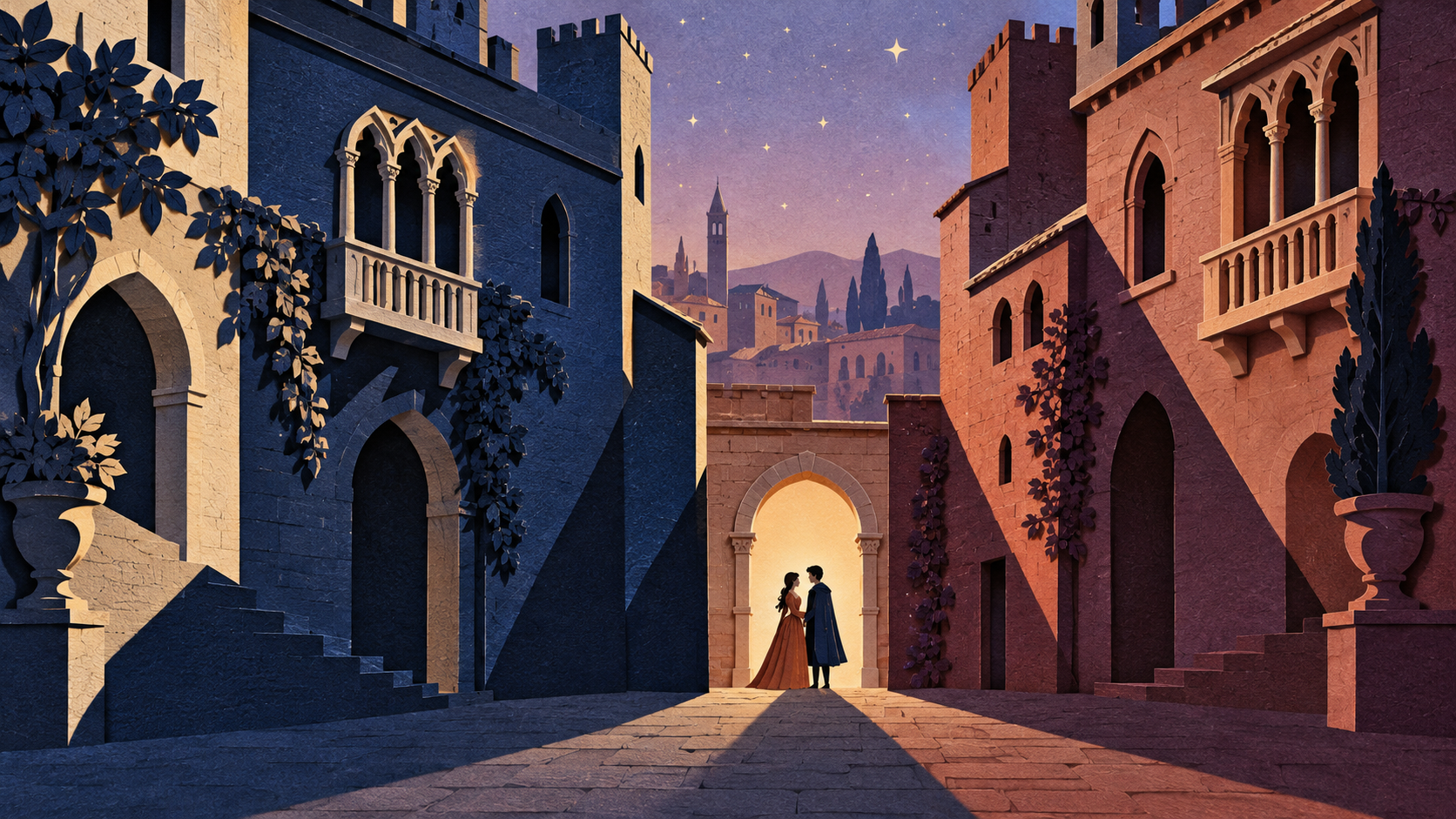
The opening Prologue of Romeo and Juliet tells us that the lovers will die before they have spoken a word. Shakespeare uses a fourteen-line sonnet to connect their love with an inherited feud, then asks the audience to watch the consequences unfold. Its form gives the tragedy a compressed outline; its language makes love and death sound inseparable.
A useful Romeo and Juliet Prologue analysis follows how those effects develop. Start with the families, examine the announcement of the deaths, then consider the Chorus’s relationship with the audience. Each movement changes what we expect from the play.
What does the Chorus tell us?
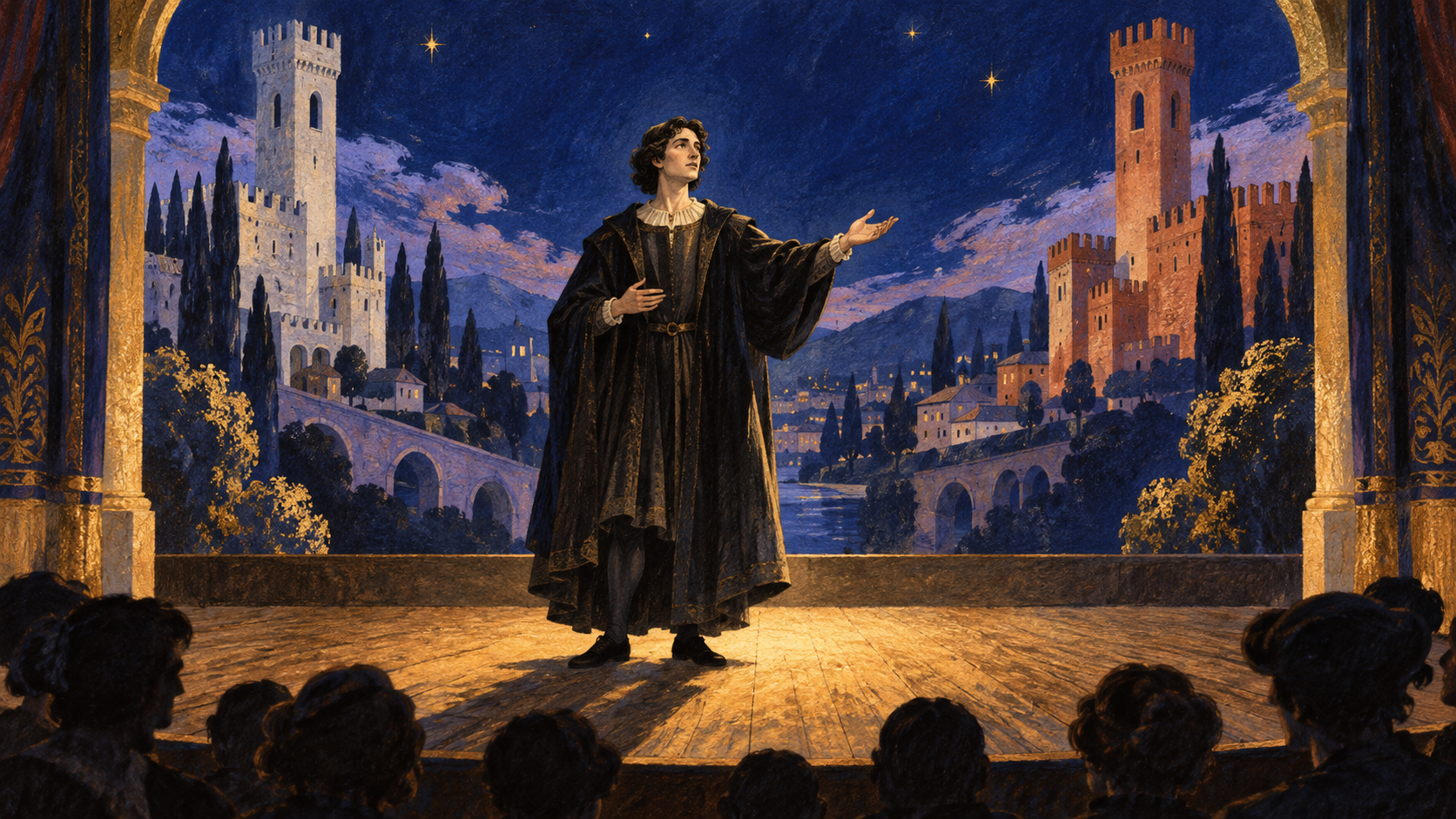
The Chorus speaks before the main action, introducing Verona, two feuding households and the lovers who come from them. This voice stands outside the immediate quarrel and gives the audience information the characters lack. The speech also announces that the lovers’ deaths will end their parents’ conflict.
That advance knowledge creates a particular kind of suspense. We watch for the choices and accidents that produce the announced ending. A hopeful encounter can feel precarious because we already know where the story leads. The Chorus supplies an interpretive frame that stays with us when the stage fills with people who believe their futures remain open.
Read the speech aloud and notice its changes of focus. The first noun gives us households; the second quatrain brings the lovers into view; the ending acknowledges the stage and its listeners. That movement provides a useful route through an essay. You can show how the opening prepares a whole theatrical experience while selecting a few words for detailed analysis.
Why is the Prologue a sonnet?
The opening Prologue takes the Shakespearean sonnet form: fourteen lines, arranged through the rhyme pattern ABAB CDCD EFEF GG. Its main rhythmic framework is iambic pentameter, a line organised around five metrical feet that generally move from a lighter syllable to a stronger one. Spoken emphasis can vary within that pattern.
The sonnet’s association with love is especially apt for a play about lovers. Yet Shakespeare fills this love-poem shape with civic violence and death. The formal connection becomes richer in Act 1, Scene 5, when Romeo and Juliet share a sonnet during their first conversation. Their mutual attraction briefly finds an answering form in the language they exchange.
Track the opening Prologue’s three quatrains, or four-line groups. Lines 1–4 establish the feud and its public damage. Lines 5–8 introduce the lovers and their deaths. Lines 9–12 identify that tragic passage as the action the theatre will present. The final rhyming couplet turns directly towards the audience.
This orderly progression can make the catastrophe feel contained within a design already complete. Treat that effect as an interpretation supported by the structure. A rhyme scheme alone cannot prove that every character has no freedom to act.
An old feud makes new violence
“Two households, both alike in dignity” opens with balance. The families share social standing, although the violence that follows immediately places their conduct under scrutiny. The equal presentation also gives us two sides of a conflict before individual personalities complicate our response.
In “From ancient grudge break to new mutiny”, “ancient” and “new” link an inherited hostility with fresh outbreaks. The cause survives across time while the damage keeps renewing itself. “Break” gives that renewal a sudden, forceful movement: a longstanding grievance erupts into public disorder.
The repetition in “Where civil blood makes civil hands unclean” draws fellow citizens into the same verbal space. Bloodshed stains the hands of people who belong to one city. “Unclean” can suggest moral contamination alongside physical staining, allowing a brief image to carry the feud’s ethical cost.
Notice how little personal explanation the Chorus supplies for the quarrel. We hear its age and consequences. That emphasis helps an essay explore how hostility becomes an accepted inheritance, maintained by people who continue to act upon it.
How does Shakespeare foreshadow the ending?
“A pair of star-cross’d lovers take their life” places the relationship beneath an adverse cosmic influence. “Star-cross’d” invokes the idea that the stars oppose the lovers. Read beside the announcement of their deaths, the phrase encourages an expectation of disaster before the relationship begins onstage.
The line also carries a grim double possibility. Coming from the “fatal loins” of the two families, the lovers take life from their parents; “take their life” also anticipates their suicides. Birth and death occupy the same short expression. Spellings differ between editions, so keep quotations consistent with the text you use.

“Death-mark’d love” brings the ending into the description of the relationship itself. The compact phrase makes love seem marked out for destruction. Meanwhile, the claim that the deaths will “bury their parents’ strife” gives death a bitter second function: it ends the conflict that helped make the relationship dangerous.
Keep human action in view when discussing fate. The Prologue names the parents’ continuing rage alongside the lovers’ doomed passage. An argument can therefore explore the tension between an apparently fixed destination and the choices that lead towards it. Our guide to structuring a Romeo and Juliet responsibility essay develops that question across the play.
For closer practice with the language and the decisions surrounding it, explore the Prologue alongside the later scenes in the Romeo and Juliet course.
The Prologue as a dramatic score
Follow the speech’s movement from the city to the audience. Form and language work together at each turn.
Lines 1–4 · The city
Form: Opening quatrain.
Language: Balanced households; old hostility erupting again.
Effect: Love will emerge inside a damaging public conflict.
Lines 5–8 · The lovers
Form: Second quatrain.
Language: Adverse stars, deaths and the burial of strife.
Effect: The audience anticipates a costly reconciliation.
Lines 9–12 · The performance
Form: Third quatrain.
Language: Doomed love becomes the stage’s business.
Effect: The summary opens into a theatrical experience.
Lines 13–14 · The listeners
Form: Closing couplet.
Language: A direct request for attentive listening.
Effect: The audience receives a role in the performance.
Why does the ending address the audience?
The phrase “two hours’ traffic of our stage” turns the story into the theatre’s business. It advertises the action to come in the shared space of performance. Use the phrase as the Chorus’s presentation of the play; actual productions can have different running times.
The final couplet asks for “patient ears” and promises that the performers’ “toil” will supply what the opening summary leaves out. Listening becomes part of the theatrical exchange. The speech moves from confident knowledge of the ending to a courteous request for the audience’s attention.
Its dramatic function therefore includes preparing us to interpret, as well as introducing the plot. We have received the destination in miniature. The actors will give it voices, bodily presence and emotional duration.
A production can colour this invitation through delivery. A solemn Chorus might make the forecast sound inescapable; a quieter, conversational voice might draw listeners towards shared reflection. These are possible staging choices. In a written analysis, explain which words permit the effect you propose, and distinguish your suggested performance from Shakespeare’s printed directions. The text introduces a Chorus without prescribing every gesture or tone.
Turn a technique into an argument
For practice, choose one short phrase and explain how it changes an audience’s expectations. Move from the precise wording to its effect, then connect that effect with the Prologue’s larger purpose. Here is an original model:
By describing the relationship as “death-mark’d love”, Shakespeare brings its ending into its first definition. The compound adjective makes destruction seem attached to love from the outset. This prepares the audience to watch the lovers’ hope with foreknowledge of loss, giving later moments of happiness a precarious quality.
Try the same approach with “ancient grudge”. Explain what its age suggests, connect it to renewed violence, and test how that prepares us for the opening street fight. Keep each observation attached to words you can point to.
The Prologue offers a compact starting point for following form, language and dramatic action across the whole play. Continue that close reading, and develop your own responses through the Romeo and Juliet course’s writing challenges.