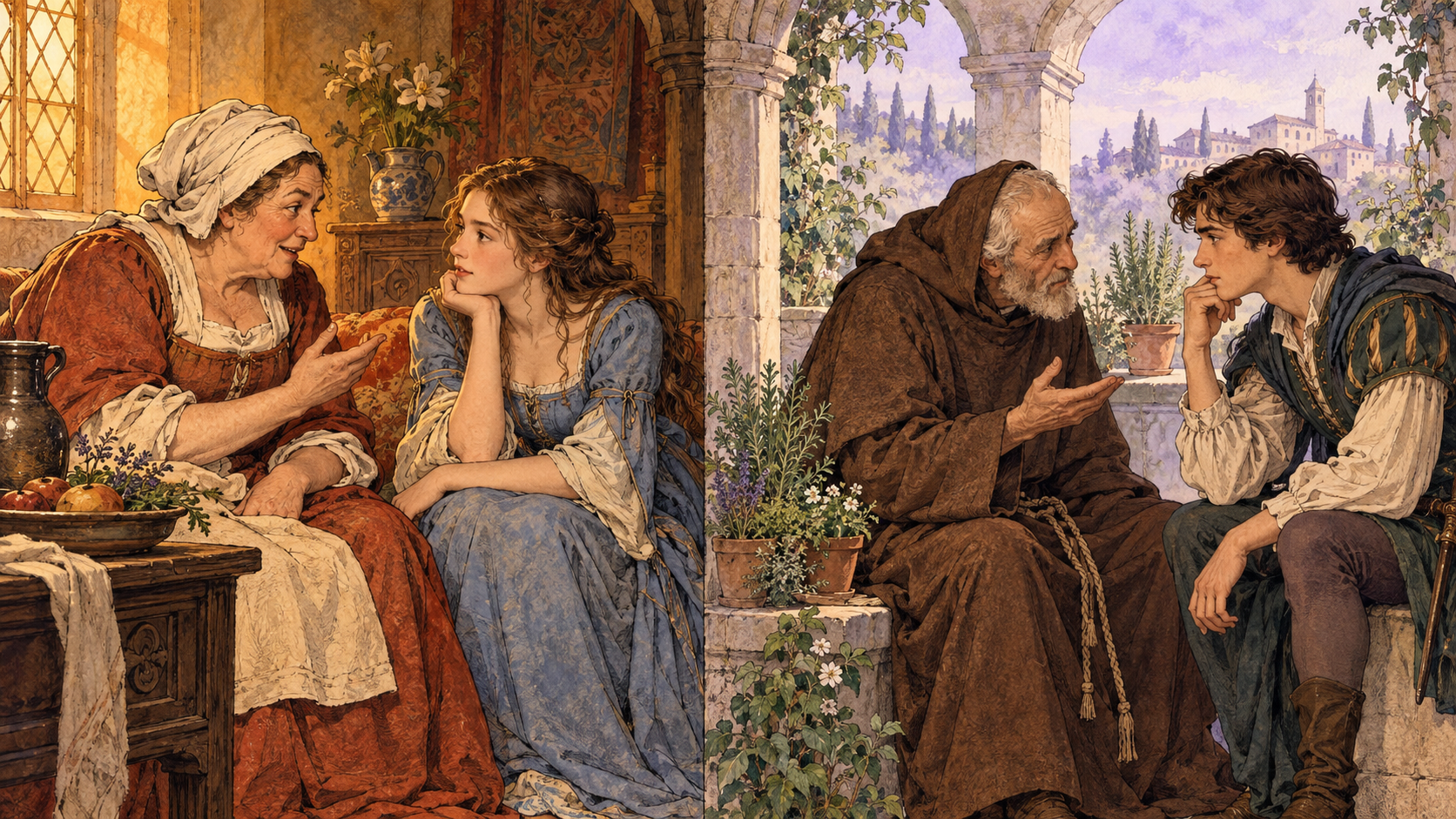
Two courtships, one household, and very different ways of discovering whom to trust. A comparison of Claudio and Hero vs Beatrice and Benedick works best when you follow a shared question through both relationships. In Much Ado About Nothing, public approval helps one match take shape; verbal sparring gives the other its distinctive energy. The wedding crisis then tests what affection can withstand.
For an essay, organise your paragraphs around those pressures. Each paragraph should bring the couples into conversation, with evidence showing how the comparison develops your argument.
Build a point-by-point comparison
Start with a question such as: How does Shakespeare use the two romances to explore trust? A useful plan might move from first impressions to other people’s influence, then examine responses to Hero’s accusation. This gives the essay a developing argument: how love begins, what shapes it and what happens under pressure.
Within each paragraph, state the shared issue, analyse one couple’s evidence, introduce the other and explain the relationship between them. Finish with the implication for your question. You can change the order of the couples. The important connection is the idea being tested.
A paragraph beginning “Claudio loves Hero” has considerable ground to cover. “Shakespeare makes public reputation a fragile foundation for intimacy” gives you a focused claim that both romances can help investigate.
Compare appearance with mutual knowledge
In Act 1, Scene 1, Claudio asks whether Hero is a “modest young lady”. His attraction is already entangled with an assessment of her reputation. Asking Benedick’s opinion also places his judgement within a male conversation. Hero’s appearance becomes something others interpret.
Beatrice and Benedick enter with an established habit of answering each other. Her “I know you of old” suggests a history that the play leaves partly unexplained. Their familiarity supports a reading of mutual knowledge, although their sharpness can also conceal hurt. Beatrice’s account of an earlier exchange of hearts in Act 2, Scene 1 hints at emotional disappointment.
This makes them useful foils: characters whose differences illuminate each other. Keep the comparison flexible. Hero’s quieter courtship contains feeling, and the witty couple still misread themselves. Verbal fluency alone offers a shaky certificate of romantic wisdom.
Two romances under the same pressures
Read across the matching stages, then choose one contrast for a paragraph.
Claudio and Hero
- Beginning, 1.1: attraction filtered through appearance and reputation.
- Social influence, 2.1: Don Pedro woos for Claudio; Leonato welcomes the match.
- Crisis, 4.1: Claudio shames Hero publicly after accepting false evidence.
- Ending, 5.4: Hero returns and marriage is renewed; damaged trust remains a question.
Beatrice and Benedick
- Beginning, 1.1: familiar wit mixes attention with resistance.
- Social influence, 2.3 and 3.1: staged overhearing encourages reciprocal affection.
- Crisis, 4.1: Beatrice demands action; Benedick agrees to challenge his friend.
- Ending, 5.4: private poems expose affection beneath public teasing.
Show how social approval shapes both matches
Don Pedro’s wooing on Claudio’s behalf and Leonato’s agreement make the first romance a publicly supported arrangement. Claudio nevertheless voices reciprocal devotion in Act 2, Scene 1. That expression complicates a claim that he feels only social ambition.
Friends also help manufacture Beatrice and Benedick’s confidence. The staged conversations in Act 2, Scene 3 and Act 3, Scene 1 persuade each that love will be returned. Hero actively helps arrange Beatrice’s change of heart: her relative quietness with Claudio should never become a claim that she has no wit or agency.
Both romances depend on information supplied by other people. Their different responses to it offer a stronger comparison than a simple opposition between arranged love and independent love. Our guide to analysing deception in Much Ado About Nothing explores how those supplied stories become persuasive.
Try connecting each influence to a particular decision. The Much Ado About Nothing course offers scene-by-scene study and writing challenges to help you develop that close reading.
Use the wedding crisis to test respect and trust
Act 4, Scene 1 brings the comparison into sharp focus. Claudio’s “rotten orange” metaphor imagines Hero as spoiled beneath an attractive surface. His accusation subjects her to public judgement while disregarding her defence. Explain how this language exposes the fragility of the reputation on which he has relied.
In the same scene, Beatrice’s “Kill Claudio” demands that Benedick’s affection acquire a practical cost. He initially refuses, then accepts her judgement that Hero has been wronged and agrees to challenge Claudio. Taking her seriously requires him to confront his own friendship group.
The demand also introduces the danger of violent redress. You can argue that their partnership develops through respect while questioning the honour code through which that respect becomes actionable. Both courtships change, and your judgement should account for their movement.

Thesis Statement Generator: strengthen three claims
Use this exercise to turn an observation into an argument. For each weak claim, choose a shared issue, name a difference and explain what Shakespeare makes that difference reveal. These possible upgrades offer starting points for your own evidence-led thesis.
Weak: The couples are different.
Upgrade: Shakespeare contrasts Claudio’s reliance on public reputation with Beatrice and Benedick’s developing willingness to trust each other’s judgement, making the wedding crisis a test of intimacy.
Weak: Beatrice and Benedick have better love.
Upgrade: Although both courtships depend on others’ interventions, Benedick’s decision to challenge Claudio suggests a growing respect that Claudio’s public treatment of Hero fails to sustain.
Weak: Both couples end happily.
Upgrade: By bringing both romances towards marriage while giving Hero limited space to address her humiliation, Shakespeare creates a comic resolution whose emotional reassurance remains open to debate.
Test your thesis against a complication. In Act 5, Scene 4, Beatrice and Benedick still need their poems produced to expose their feelings. Claudio and Hero’s reunion follows the exposure of the fraud. The ending offers reconciliation while leaving the audience to judge how fully trust has recovered.
Model comparative paragraph: keep both couples in view
Here is an original model showing how a shared issue can hold a paragraph together:
Shakespeare uses the wedding crisis to distinguish public reputation from the respect that intimacy demands. Claudio’s description of Hero as a “rotten orange” reduces her to an object whose attractive surface supposedly conceals corruption. The metaphor reveals how quickly his admiration becomes contempt when her reputation appears threatened. Within the same scene, Beatrice asks Benedick to act on her conviction that Hero has been wronged. His eventual agreement to challenge Claudio makes taking her judgement seriously costly to his male friendships. The juxtaposition suggests that love develops through responsibility towards another person’s understanding and suffering. Yet the proposed violence complicates this growth: Beatrice and Benedick seek justice through the honour system that has helped produce the injury. Their romance offers a developing alternative whose ethical difficulties remain visible.
The paragraph moves between the couples through respect, then qualifies its judgement. In your own draft, check that each quotation advances that shared issue. Follow another turning point through both romances in the Much Ado About Nothing course, using the scene’s language to build a comparison you can defend.