‘Did you lock the side door?’ she asked.
The question mark belongs to Iona’s words. The lower-case she tells us that the sentence on the page is still going. That small distinction explains much of how to punctuate dialogue. A speech tag such as she asked attaches to the words. An action such as She set down the keys stands as a sentence of its own. When someone else speaks, start a new paragraph.
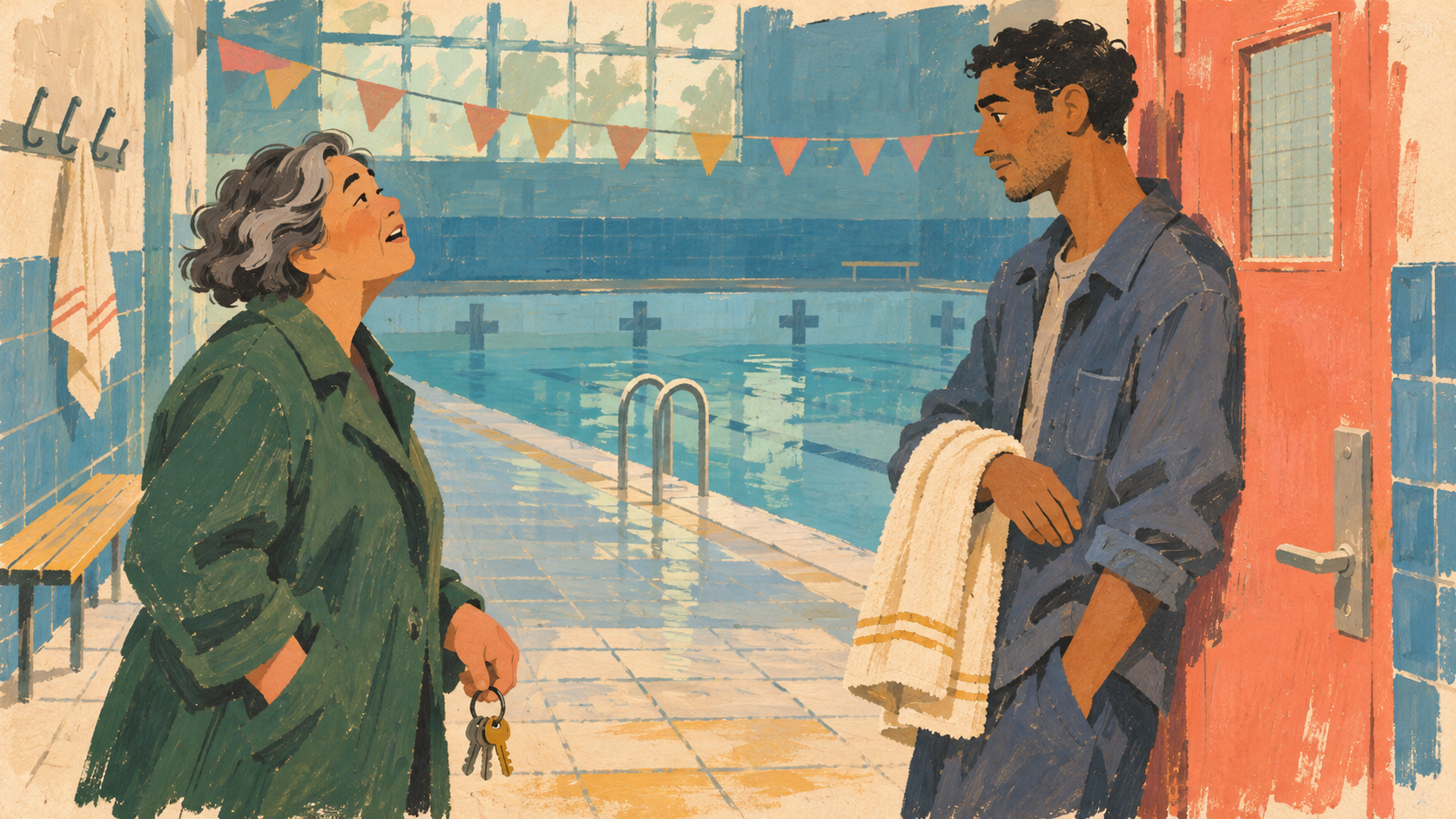
All three conventions come into play in the same short exchange below. Iona and Raf are closing a municipal swimming pool, and somebody has left a light on.
Contents
Read the scene
Watch the space between the paragraphs as well as the punctuation inside them. Iona gets the first turn. Raf takes the second, and the exchange alternates until he goes to check the pump room.
‘Did you lock the side door?’ she asked.
Raf shifted the towel on his arm. ‘I locked it before nine,’ he said.
Iona set the keys on the ledge. ‘Then why is the light still –’
‘That’s the pump room.’ He pointed to the window above the door. ‘The switch is on a timer.’
‘Raf,’ she said, ‘the timer broke on Tuesday.’
‘I thought they’d fixed it…’ He set the towel beside the keys. ‘I’ll go and check.’
The opening tag uses she because we’ve already introduced Iona. If this were the first line of a story with no lead-in, Iona asked could do the same grammatical job and establish who spoke. A name keeps its capital after the question mark. The pronoun shows the lower-case rule more clearly.
Punctuate speech tags
A speech tag tells the reader who says a line, sometimes with a hint of delivery. In ‘I locked it before nine,’ he said, the comma sits inside the closing quotation mark because he said continues the sentence. The full stop goes after said. Move the tag to the front and the comma comes after the tag instead. The complete spoken sentence now ends with a full stop inside its quotation marks.
He said, ‘I locked it before nine.’
A spoken question keeps its question mark. A spoken exclamation works the same way. In ‘Did you lock the side door?’ she asked, she stays lower-case and there’s no extra comma after the question mark. If Iona had shouted ‘Wait!’ and the tag followed, you could write ‘Wait!’ she shouted. The tag still belongs to the same sentence. In each case the full stop after the tag closes the whole construction.
A tag can also sit inside one spoken sentence. Take the tag out of ‘Raf,’ she said, ‘the timer broke on Tuesday.’ What remains is ‘Raf, the timer broke on Tuesday.’ The words after the tag carry on the original sentence, so the starts with a lower-case letter. If Iona says two complete sentences, give the tag a full stop and start the next sentence with a capital.
‘Raf,’ she said. ‘The timer broke on Tuesday.’
Read both versions aloud. The first lets the name run into the reminder. The second gives Iona a moment to get Raf’s attention before she tells him what he’s forgotten. The punctuation gives the reader that moment on the page.
Give action beats their own sentences
An action beat is a short piece of narration alongside speech. It might show a character putting something down, turning to look or moving across the room. In the pool scene, Raf’s pointing hand directs Iona’s attention to the window. His action is a complete sentence. Give the preceding speech a full stop and start the action with a capital.
‘That’s the pump room.’ He pointed to the window above the door.
With a question, the question mark stays in the speech. The capital at the beginning of the next sentence now tells us we’ve moved into action. Compare ‘Did you lock the side door?’ she asked with ‘Did you lock the side door?’ She set the keys on the ledge. The punctuation inside the quotation marks is identical. What follows the quotation determines the case of the pronoun.

When a draft reads ‘That’s the pump room,’ he pointed to the window, look at the job pointed is doing. Here it describes a gesture, so punctuate it as an action. If the sentence needs both an attribution and a gesture, you can attach the gesture to a tag. For example, ‘That’s the pump room,’ he said, pointing to the window. Now said carries the speech, and pointing tells us what he does as he says it.
Read the join between speech and narration
The same words can hand over to a tag or to a new sentence.
‘That’s the pump room,’ he said.
Comma and lower-case h
The tag continues the sentence.
‘That’s the pump room.’ He pointed.
Full stop and capital H
The action starts a new sentence.
When Iona speaks, make the break visible.
‘That’s the pump room.’ He pointed.
‘Then why is the light on?’ she asked.
If you’d like more practice moving between speech and action, WriteCraft Pro includes creative-writing exercises on dialogue and character.
Start a new paragraph for a new speaker
Even a one-word answer needs its own paragraph when it comes from somebody else. A reader sees a fresh paragraph and expects a fresh turn. Keeping Iona’s speech and Raf’s answer in the same paragraph makes the reader wait for a tag to work out where the exchange changed hands.
When the same person continues, their speech and action can share a paragraph. Raf says ‘That’s the pump room.’ He points, then explains the timer. All three sentences belong in his turn. If Iona is the one who points and then speaks, put her gesture with her own words in a new paragraph. That keeps the movement attached to the character who makes it.
With just two people, you can leave out some tags once the exchange is established. Read the page with only the first tag and the paragraph breaks to guide you. If a long action or a third voice makes the turn unclear, bring back a name or put a distinctive action next to the speaker’s line. The guide to writing believable dialogue takes up what happens once the reader can follow the voices.
Show interruptions and trailing off
In Iona’s ‘Then why is the light still –’ the dash falls inside the closing quotation mark because the break happens in her speech. Raf cuts in on the next line, so he gets a new paragraph. There’s no full stop after the dash. The abrupt stop is already visible.
Raf’s ‘I thought they’d fixed it…’ fades out. The ellipsis lets the line hang while he sets down the towel. His action then starts a new sentence. Try exchanging the dash and the ellipsis in these two lines. Iona now sounds as if she loses confidence in her own question. Raf sounds as though something stops him mid-thought. The two marks ask for different readings.
Some pauses need only a sentence break and an action. ‘The switch is on a timer.’ He glanced at the dark window. ‘Or it was.’ The movement gives the reader time to reconsider the first statement. It also leaves a clean join between two complete pieces of speech.
Choose quotation marks and house style
Single quotation marks are common in British fiction, and double quotation marks are common in US fiction. Publishers can choose either. This scene uses single marks on the outside. If Iona quotes someone inside her own dialogue, the inner quotation uses double marks, as in ‘You said “before nine”, didn’t you?’ The question mark comes after didn’t you because it belongs to Iona’s question. The words before nine are the smaller quotation within it.
Dash length and spacing also vary. The scene uses an en dash with a space before it at the end of interrupted speech. Chicago style typically uses an em dash closed up to the preceding word. For a submission, follow the publisher’s or competition’s guidance. For a draft without a specified house style, write down your choices for outer quotation marks, dashes and ellipses. That gives you a short checklist when you come back to edit.
Try the error-spotting exercise
Here’s an alternate draft of the pool exchange. The first line belongs to Iona. Raf gives the reply and points to the window. Iona asks about the light, and Raf cuts in again. Fix the punctuation, the capitals and the missing paragraph break before reading the answers.
‘Did you lock the side door?’, She asked. ‘I locked it before nine,’ he pointed to the window.
‘Then why is the light still…’
‘That’s the pump room’ he said.
One corrected version
‘Did you lock the side door?’ she asked.
‘I locked it before nine.’ He pointed to the window.
‘Then why is the light still –’
‘That’s the pump room,’ he said.
- Keep the question mark and lower-case the tag. The mark already closes the spoken question. The tag continues the sentence, so remove the extra comma and use she.
- Move Raf’s reply into its own paragraph. A new speaker has taken over. Use a full stop inside the quotation mark and capitalise He because pointing is a separate action here.
- Give Iona’s interrupted line a dash. The exercise calls for Raf to cut her off. The ellipsis in the draft made it sound as though she trailed away on her own.
- Put a comma inside the closing quotation mark before he said. This time Raf’s speech is followed by a tag, so the full stop belongs at the end of the tag.
Now take half a page of your own dialogue. Follow the speakers first, then check each place where speech hands over to narration. If you stumble over a line, name the job of the words after the quotation. Once you can tell a tag from an action, the punctuation usually follows.
When you’re ready to revise a longer scene, WriteCraft Pro gives you exercises and personalised feedback to help you see how a reader follows the exchange. The course introduction shows how that practice works.