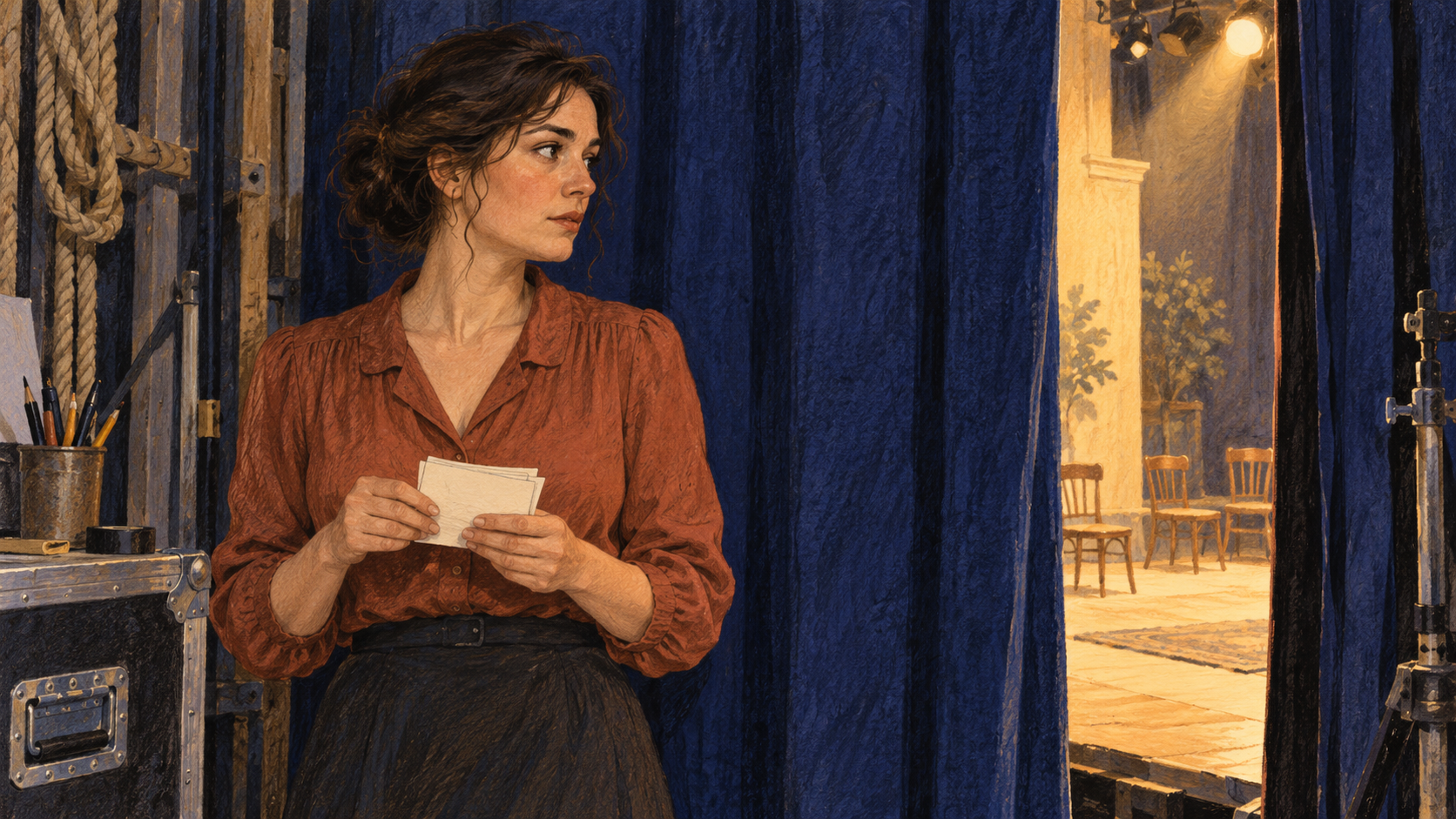
Leah squared the corners of her cue cards. The edges were already level. Beyond the curtain, someone moved a chair, and she started again.
Learning how to show nervousness in writing starts with what a character wants and fears losing. A small, purposeful detail can give the feeling a place in the scene. The eight original mini-scenes below explore attention, dialogue, thought and action, with a revision task you can try yourself.
Give the nervousness a specific pressure
Start by asking what could go wrong for this person here. A speaker may fear forgetting a name; a repairer may dread admitting that he damaged a customer’s shoes. Their immediate worries give you different details to work with. Familiar phrases such as “butterflies in her stomach” communicate quickly, but can leave the character’s particular predicament hazy.
Showing and telling are both useful. “She was nervous throughout the journey” can move a story efficiently towards the meeting that deserves a full scene. Spend detail where the emotion changes a decision, a conversation or the reader’s understanding.
Let attention reveal the pressure
A viewpoint character selects what reaches the page. Choose something they keep noticing because of the risk ahead. You can leave most of the room undescribed.
1. The cue cards: revise a familiar phrase
Familiar version: “Leah had butterflies in her stomach before her speech.”
Leah checked the first card. Welcome. Seven letters, all accounted for. She turned it over to check that she had numbered the back.
The revision lets preparation become excessive. “All accounted for” gives her checking a faintly comic seriousness. We can infer that this ordinary opening word has begun to feel like an obstacle. Choose this slower version when the wait deserves space.
2. The footstep that interrupts everything
Every time the stair creaked, Arun stopped practising his apology. The landlord lived upstairs. Arun had already found three ways to explain the broken window; none survived a footstep.
The sound gains meaning through the apology. A creaking stair in another scene might be comforting. Here it repeatedly interrupts Arun’s attempt to prepare, keeping the anticipated confrontation close.
Let speech try to manage the situation
Nervous dialogue can involve rehearsing, volunteering unnecessary information or trying to settle a question too early. Give the speaker a conversational aim. Stammering is one possible choice, alongside many others.
3. Answering the question too soon
“The blue folder is the final version,” Mo said.
“I haven’t asked about the folder.”
“I know. Just saving us a minute.” She slid the older copy beneath her chair.
Mo tries to control which version gets discussed. Her brisk explanation and concealed copy suggest the pressure behind the exchange. The action adds information that her words try to keep out of sight.
4. Politeness that becomes elaborate
“Would you like tea? Coffee? I have the little biscuits, if those are still your sort.” Elena opened the cupboard. Her brother had only asked whether they could talk about their father’s will.
Hospitality gives Elena a familiar task while a difficult subject waits. Her reference to his tastes also hints at distance between them. For another character, the same worry could produce clipped answers. Use speech habits that fit the relationship.
For a closer look at what each reply is doing, try our worked revisions of an unnatural conversation.
Give the character’s thoughts a task
Interior thought can make the feared outcome precise. Let it follow the character’s immediate problem, vocabulary and assumptions. A thought can be brief enough to sit inside an unfolding action.
5. Rehearsing the wrong detail
Mrs Vale. Definitely Mrs Vale. Tessa repeated the name as the interview door opened, then realised she had forgotten the first sentence of every answer she had prepared.
Tessa’s concentration narrows around a manageable detail. The timing creates a small reversal: the door opens just as her preparation slips away. You can convey this pressure through the thought itself without adding a separate bodily reaction.
6. Bargaining with an ordinary object
If the kettle clicked off before Dad reached the kitchen, Sam would tell him about the dent. The kettle clicked. Sam lifted it from its base and set it down again.
Sam invents a condition for speaking, then delays when it arrives. The thought and action expose the gap between intention and readiness. Readers also have a concrete question to carry forward: when will Sam finally speak?
One pressure, four ways into a scene
Begin with the risk: someone is about to discover something.
Attention
What keeps interrupting?
Arun: the stair creaks; the apology stops.
Dialogue
What does the speaker try to control?
Mo: the conversation moves towards the blue folder.
Thought
What condition delays the admission?
Sam: the kettle becomes a private deadline.
Action
What useful task becomes unnecessary?
Idris: the brushes need straightening again.
Choose the detail that fits your character’s situation. You can build a scene around a single channel.
Let action carry the hesitation
Give hands, feet and objects something consequential to do. A familiar task can offer a character somewhere to put their effort while they postpone a harder one.
7. Making a finished job tidier
Idris straightened the three brushes on the counter. Through the glass, his customer raised a hand. Idris straightened the brushes again, leaving the damaged shoes in their box.
The repeated action buys a moment before the admission. His skill at organising the workshop sits beside his reluctance to face the customer. The shoes keep the source of the worry visible.

8. Keeping moving when you want to stop
Nadia reached her sister’s gate, walked past it, then stopped at the next house. She checked the flowers for broken stems. Everything was intact. She turned back.
Nadia’s movement stretches the approach. The flowers suggest that the visit has a purpose, while her unnecessary inspection delays it. Earlier context can establish whether she is bringing an apology, seeking a reconciliation or arriving after a long absence.
Practise a nervous moment with a clear cause
Revise this starting point: “Ben was very nervous before telling his flatmate he was moving out.” Write about 70 words. Decide what Ben fears his flatmate will say, then choose one detail from their shared home and one action that delays the conversation.
One possible response:
Ben took his mug from the draining board. He had chosen it with Alice on their first Saturday here: yellow, with a handle too small for either of them. “Have we got any boxes?” he asked. Alice looked up from the shopping list. Ben put the mug back, carefully matching its handle to the angle of hers. “There’s something I need to tell you.”
The shared mug gives the departure emotional weight. His question approaches the news indirectly; the final line begins the conversation. Check whether your detail belongs to this relationship and whether the scene moves by its end. Keep any plain statement of feeling that helps the reader follow it.
Try the exercise again with a different character: someone eager to leave who fears seeming unkind. The same flat can yield a different scene. WriteCraft Pro offers further creative writing practice and personalised feedback as you develop those choices.