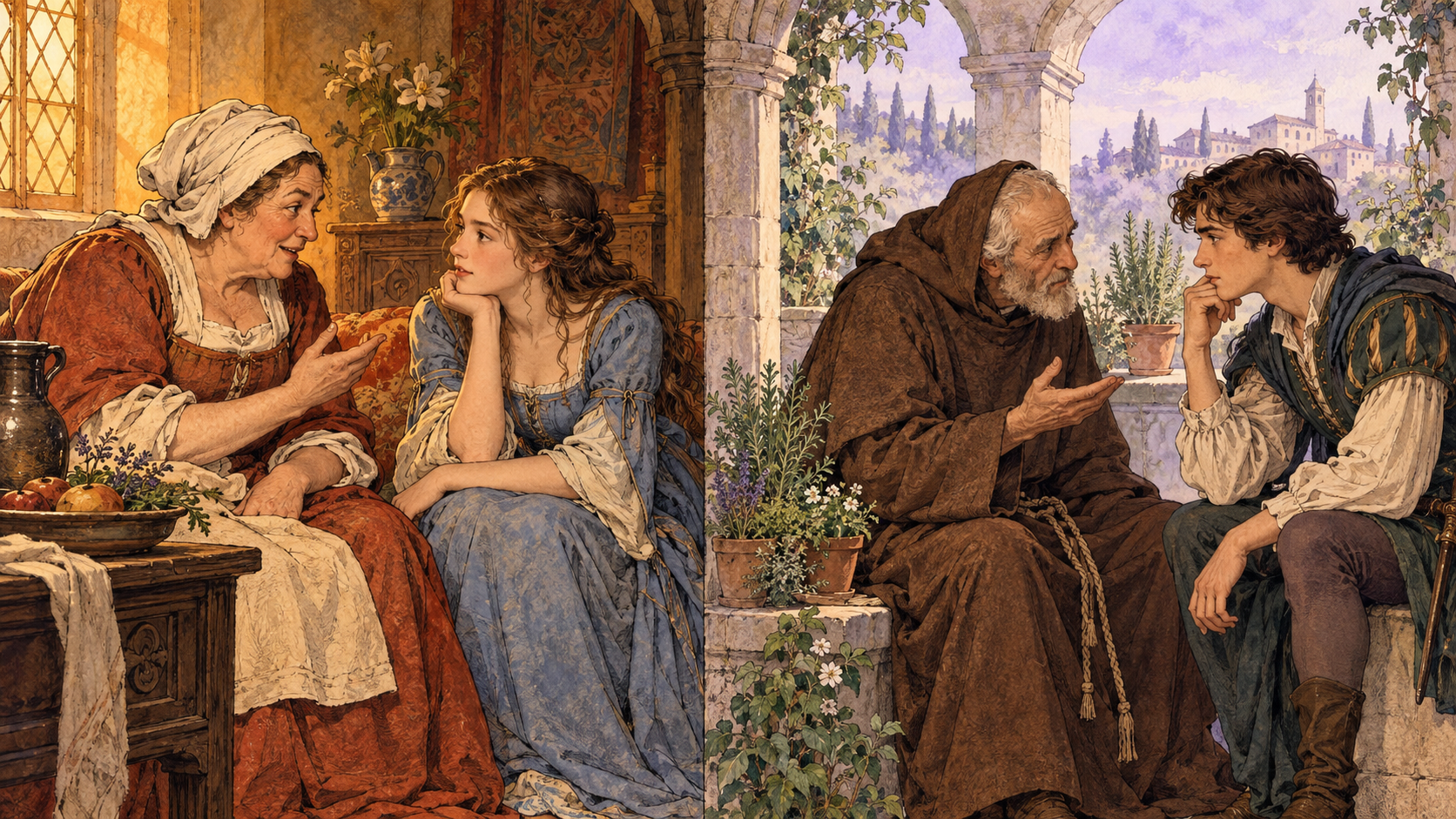
Duncan rewards loyalty, Macbeth fears it, and Malcolm checks it before placing his trust. Those different responses give an essay on kingship in Macbeth a clear direction. Shakespeare asks how a ruler acquires authority, judges other people and uses power once it is his.
A strong comparison can hold two ideas together: Duncan provides an ethical standard that Macbeth destroys, while Malcolm offers a more cautious version of legitimate rule. Duncan's judgement is fallible; Malcolm's government is still a promise when the play ends. Those qualifications give the argument somewhere to go beyond assigning each king a good or bad label.
Three questions for comparing kingship
Begin with criteria you can apply to each ruler. Legitimacy concerns the basis of a person's claim to rule. Judgement concerns how he reads people and makes decisions. Service concerns whose interests his government protects. Keep returning to the same questions so the essay develops a comparison across the play.
Duncan is the established king and publicly names Malcolm as his successor in Act 1 Scene 4. Macbeth reaches the throne after murdering Duncan; Act 2 Scene 4 reports his selection and journey to Scone for investiture. He therefore possesses the office, even while the play exposes the crime beneath it. Malcolm combines a hereditary claim with the support that helps him overthrow Macbeth.
That distinction keeps the argument precise. Calling Macbeth a tyrant describes how he governs and how his authority is judged. Simply saying that he is never really king would obscure the frightening reach of his actual power. His orders can destroy households.
Duncan: generosity and vulnerable judgement
In Act 1 Scene 4, Duncan thanks Macbeth and Banquo for their military service. He imagines his relationship with Macbeth through cultivation: “I have begun to plant thee”. The metaphor presents royal reward as nourishment. Under this model, a capable subject should flourish because the king recognises and supports his service.
This exchange also makes kingship reciprocal. Macbeth has defended the kingdom; Duncan owes him recognition. Duncan's warmth encourages a picture of government sustained by gratitude, with honour flowing outwards from the throne. When Macbeth later plots against him, the audience has already heard what loyal service ought to sound like.
Yet the scene begins with Duncan confronting his mistaken trust in the previous Thane of Cawdor. His admission that “There's no art / To find the mind's construction in the face” acknowledges the difficulty of reading concealed intentions. Macbeth enters immediately afterwards. That sequence gives the audience a reason to worry about the king's next judgement.
Be careful with the conclusion you draw. Duncan's failure to detect treachery supports an argument about political vulnerability. It supplies no justification for his murder. Nor does the scene prove that kindness itself produces bad government. The sharper point is that generous authority needs discernment, and Duncan struggles to distinguish the loyal subject from the convincing performance of loyalty.
Macbeth's own assessment in Act 1 Scene 7 strengthens Duncan's moral standing. He recognises the king's virtues while considering the murder. The praise comes from the man planning to betray him, which gives it a particular dramatic force: Macbeth understands the standard he is choosing to violate.
Macbeth: power organised around fear
Once crowned, Macbeth finds possession of the throne insufficient. In Act 3 Scene 1, he says, “To be thus is nothing, / But to be safely thus.” The repeated “thus” reduces kingship to a condition he wants to secure. His attention turns towards threats to his position, especially Banquo and the promised succession of Banquo's descendants.
Compare this with Duncan's welcome to successful soldiers. Duncan rewards the men who have defended Scotland. Macbeth arranges the death of a former companion whose qualities make him threatening. Talent and courage become reasons for suspicion. A ruler who treats distinguished subjects as dangers consumes the resources that could sustain his kingdom.

The consequences spread beyond rivals at court. Macbeth orders violence against Macduff's household in Act 4 Scene 1, and the following scene stages the attack. The gap between the absent opponent and the vulnerable people punished in his place shows how far royal force has moved towards personal retaliation.
In Act 4 Scene 3, Scotland's suffering enters the conversation between Malcolm and Macduff. Their discussion makes the condition of the country a test of leadership. An essay can trace this change in scale: Macbeth's private wish for safety creates public insecurity. His fear acquires agents, orders and victims.
Keep the comparison attached to specific choices. “Macbeth is evil” leaves little to analyse. “Macbeth turns the protection of his position into the purpose of government” opens up his language, his treatment of Banquo and the damage inflicted on families. It also prepares a meaningful comparison with Malcolm's proposed responsibilities.
If the political language needs a little background, our guide to using Macbeth's Jacobean context in an essay explains how to connect context to particular passages. Keep the evidence from the scene at the centre of this comparison.
Malcolm: tested loyalty and promised repair
Malcolm's conversation with Macduff in Act 4 Scene 3 revisits Duncan's problem of knowing whom to trust. Having escaped Scotland, Malcolm suspects a trap. He claims to possess appetites and vices that would make him a disastrous ruler, watching how Macduff responds. These claims are a deliberate test; he later retracts them.
That distinction is essential when quoting the scene. Malcolm's apparent confession cannot serve as straightforward evidence that he is corrupt. The dramatic question concerns what he learns by pretending. Macduff initially tries to accommodate the faults, then recoils when Malcolm imagines destroying peace and unity. His despair for Scotland helps establish that his loyalty has a public purpose.
Within the test, Malcolm names the “king-becoming graces”, including justice, truthfulness, moderation and mercy. The list supplies a vocabulary for assessing all three rulers. Macbeth's violence violates that standard. Duncan's generosity answers part of it, while his misplaced trust reveals the additional need for careful judgement.
Malcolm's caution can therefore be read as an answer to his father's vulnerability. His approach also creates discomfort: he makes a potential ally endure a painful fiction. You can acknowledge that cost while arguing that the scene presents trust as something a ruler must examine. A thoughtful interpretation leaves room for the tension between prudence and manipulation.
To develop this kind of reading across the play, the Macbeth course combines scene explanations with writing challenges and opportunities to explore your interpretation.
At the end, Malcolm promises to recall exiles and bring Macbeth's cruel agents to account. These are practical tasks of restoration. His speech directs attention towards people displaced by the previous regime and work that remains to be done. Shakespeare ends with the prospect of repair; an extended record of successful government lies beyond the play.
Bring the rulers into one argument
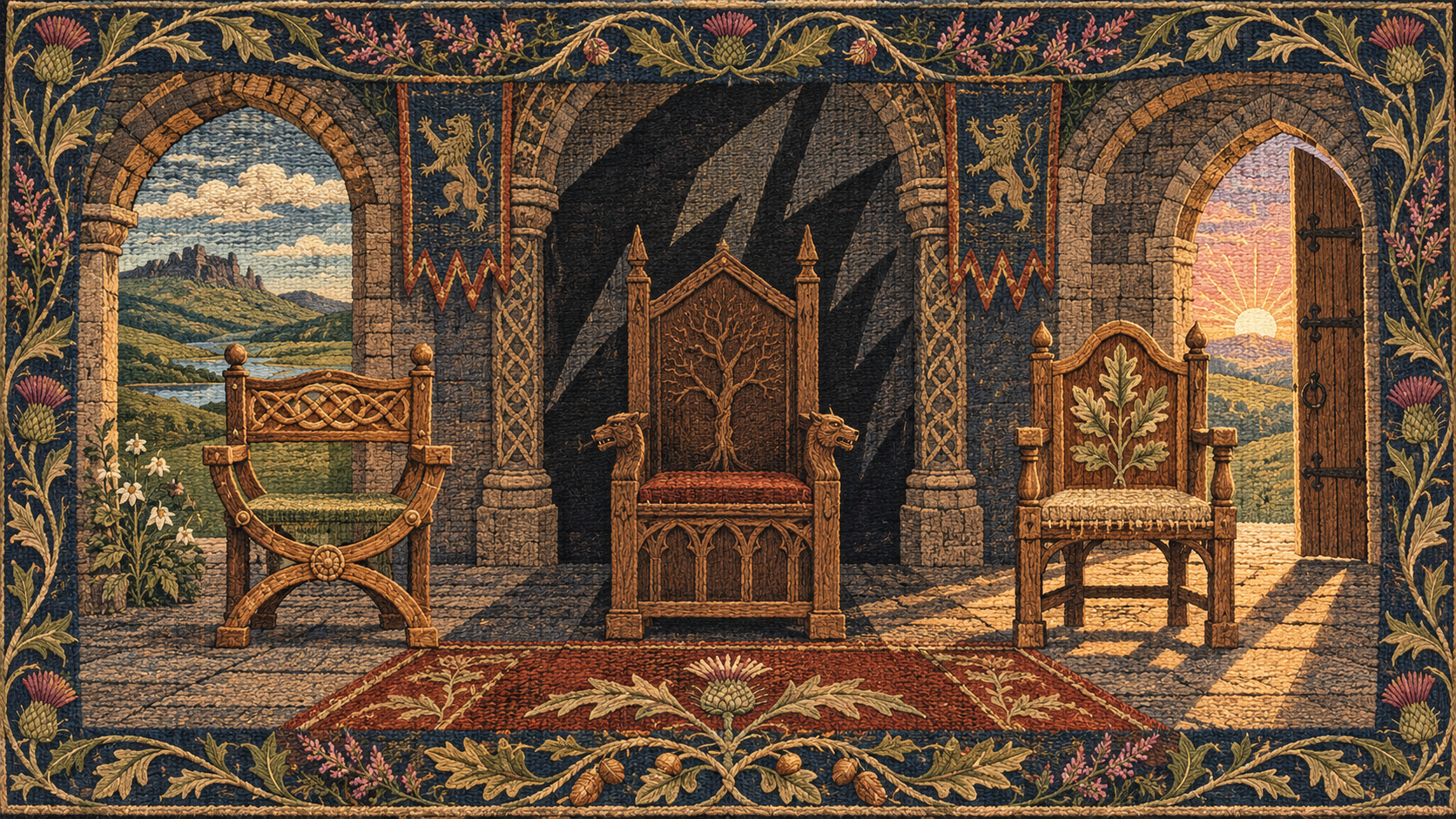
Use the visual below as a planning device. Read across each ruler's evidence, then follow one question through all three. The final judgement should explain the relationship between their approaches.
At the council table: whom does power serve?
Three evidence trails, one question for Scotland.
DUNCAN / recognition
1.4: rewards service and imagines growth.
Pressure point: his confidence in appearances leaves him exposed.
MACBETH / self-protection
3.1 and 4.1: perceived threats generate murder orders.
Public cost: the ruler's search for safety endangers others.
MALCOLM / responsibility
4.3 and the final scene: tests allegiance, then promises restoration.
Open question: how will his promises become government?
Your argument: connect each ruler's judgement of others to the condition of the country.

A useful thesis might argue that Shakespeare joins rightful authority to ethical responsibility, while showing why benevolence needs political judgement. Duncan establishes the value of generous rule, Macbeth reveals the devastation of self-serving power, and Malcolm offers cautious hope through tested loyalty and promised repair.
Organise paragraphs around those relationships. One could compare Duncan's trust with Malcolm's suspicion; another could compare Macbeth's use of force with Malcolm's plans for Scotland. This lets each paragraph advance an idea across characters, avoiding three miniature character biographies placed side by side.
A model comparative paragraph
The following original paragraph focuses on judgement. It offers one defensible reading, with a qualification that grows from the evidence.
Shakespeare presents political judgement as a necessary companion to legitimate kingship. In Act 1 Scene 4, Duncan admits that a face cannot reveal a person's hidden mind, yet immediately welcomes Macbeth into his confidence. The entrance makes his uncertainty dramatically urgent: the audience sees another trusted subject who will betray him. Malcolm approaches the same problem through deliberate testing in Act 4 Scene 3. By pretending to lack the virtues required of a king, he discovers whether Macduff will place Scotland's welfare above loyalty to a royal claimant. His caution suggests a response to Duncan's vulnerability, although its painful deception complicates an entirely reassuring view of him. Through this contrast, Shakespeare makes effective rule depend on the difficult work of distinguishing genuine service from persuasive appearances.
The paragraph identifies one shared problem, analyses a dramatic choice and moves to a precise comparison. Its final sentence develops the claim from both scenes. You could extend it with a short quotation from Malcolm, provided you explain the test and keep clear which claims he retracts.
Practise a qualified comparison
Write 120–160 words answering this question: How does Shakespeare distinguish the ruler's personal security from the country's welfare? Begin with Macbeth's language in Act 3 Scene 1, then compare Malcolm's intentions in the final scene. Select a short phrase from each passage and explain how its wording supports your argument.
Check that you have named the speaker, established the situation and discussed an effect of language or staging. Replace a broad judgement such as “Malcolm fixes everything” with a claim the ending supports: he announces tasks of restoration. That small adjustment keeps hope in the argument while respecting the limits of the evidence.
The most productive comparisons keep testing a ruler's words against his decisions. To carry that practice into other scenes, explore the Macbeth course and develop your reading through focused writing challenges.