Dogberry has two men in custody and a wedding about to begin when he goes to see Leonato. We already know what the men were arrested for. We also know what Claudio plans to do to Hero at the ceremony. All the constable has to do is tell Leonato why the arrests were made. First, though, he would like to discuss Verges’s conversational habits.
Dogberry, the constable in Shakespeare’s Much Ado About Nothing, wants to sound equal to his office. His habit of reaching for impressive words makes him funny, and his attempts to command a hearing make him important to the plot. The Watch gets hold of the evidence that clears Hero. Shakespeare stretches the time between its discovery and the moment the people with power take it seriously.
Contents
Dogberry’s malapropisms
A malapropism occurs when a speaker uses a similar-sounding word by mistake. The mistake can produce a meaning quite different from the one the speaker intends. Shakespeare gives Dogberry several of these slips while the constable is trying hardest to sound official. Listen for the intended word, then ask what the word he actually says does to the sentence. In a Dogberry character analysis, those choices can show what he wants his listeners to think of him.
- “Comprehend” for “apprehend” (3.3). Dogberry tells the Watch to “comprehend all vagrom men”. He means they should detain vagrants. The slip makes it sound as if the patrol has been told to understand the people it stops. The next part of the order, to command them to halt in the Prince’s name, gives away the intended meaning.
- “Confidence” for “conference” (3.5). Dogberry asks Leonato for a conversation about an urgent matter and reaches for a word that suggests trust or a secret instead. A reasonably formal opening becomes hazy just when Leonato needs to know what the visit is about.
- “Odorous” for “odious” (3.5). Trying to rein in Verges, Dogberry invokes the saying that comparisons are odious, or objectionable. In his version they smell. The familiar shape of the saying makes the wrong word easy to hear. The person telling someone else to get to the point has supplied a distraction of his own.
- “Excommunication” for “examination” (3.5). Dogberry wants a clerk to write down the questioning of the prisoners. The word he chooses suggests expulsion from the Church. The formality of the word suits his mood even as its meaning wanders away from the business at hand.
Some of the funniest moments work at the level of a whole exchange. After ordering the patrol to make men stop, Dogberry advises letting a man go if he refuses. Each instruction sounds like a ruling while he is delivering it. Put the two together and the rule offers a remarkably easy way to walk away.
What the Watch hears
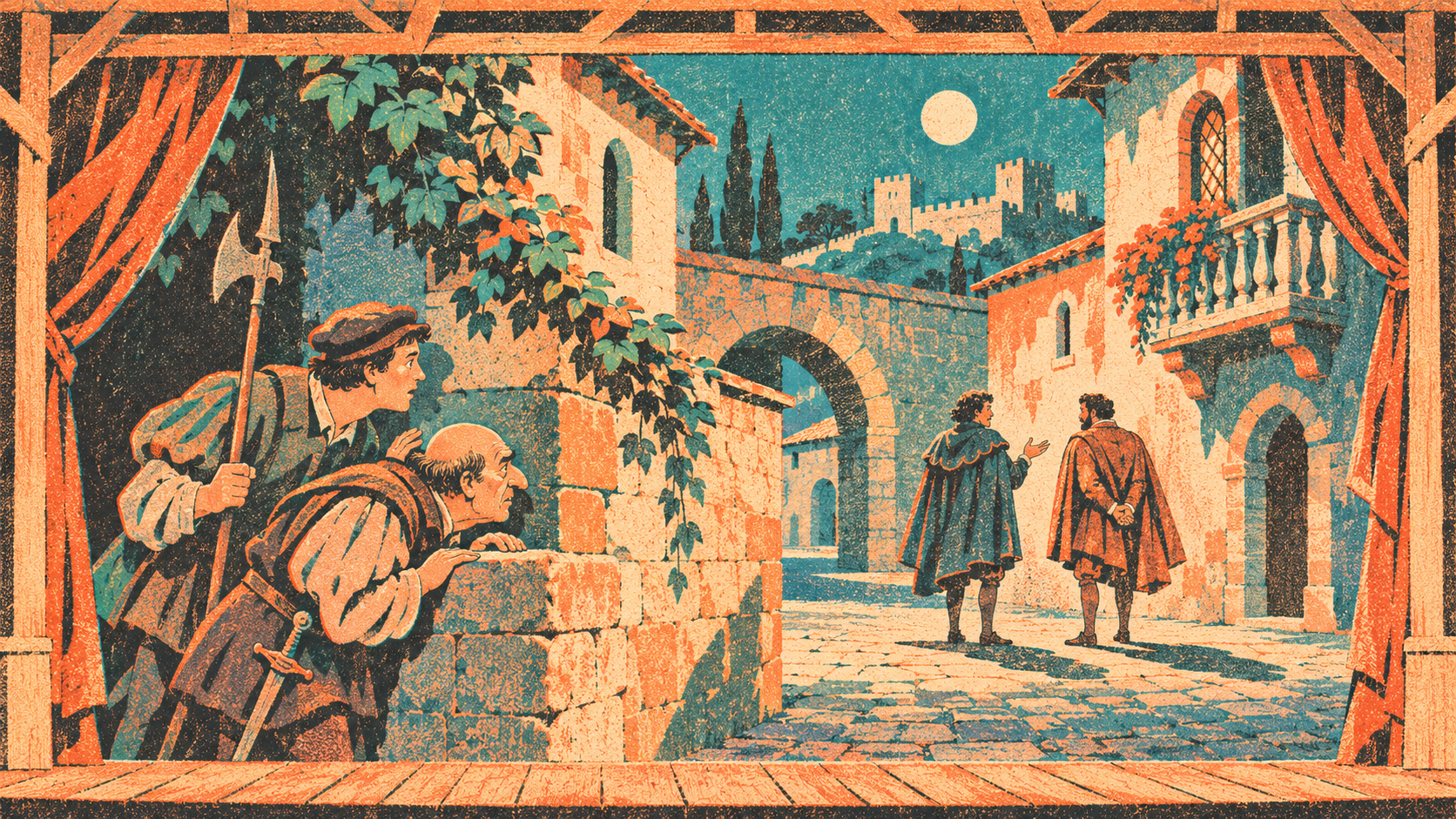
In Act 3, Scene 3, Borachio tells Conrade how he courted Margaret while Don Pedro and Claudio were watching from a distance. They took her for Hero. The audience gets the account through Borachio’s telling, as the hidden Watch does. His boast supplies the missing information about what the two noblemen thought they saw. Our guide to writing about deception in the play follows Claudio’s side of that mistake.
One watchman hears Borachio describe fashion as a “deformed thief” and takes Deformed for the name of a wanted man. This joke depends on how the listener divides up the sentence. The same patrol hears enough of the boast to arrest Borachio and Conrade. Shakespeare lets the audience catch the watchman’s mistake even as the Watch makes the most consequential discovery of the night. Their success comes with a joke about how easily any listener in Messina can run away with the wrong idea.
Why the report stalls before the wedding
Leonato’s request, “Brief, I pray you”, gives the scene its pace. Dogberry speaks as if courtesy and careful preliminaries will earn him a hearing. Verges gets as far as reporting that two men have been taken. Dogberry interrupts him to apologise for his talkativeness and proceeds to demonstrate his own. An actor can keep leaning into the prospect of the real news, while the audience waits through each new detour.
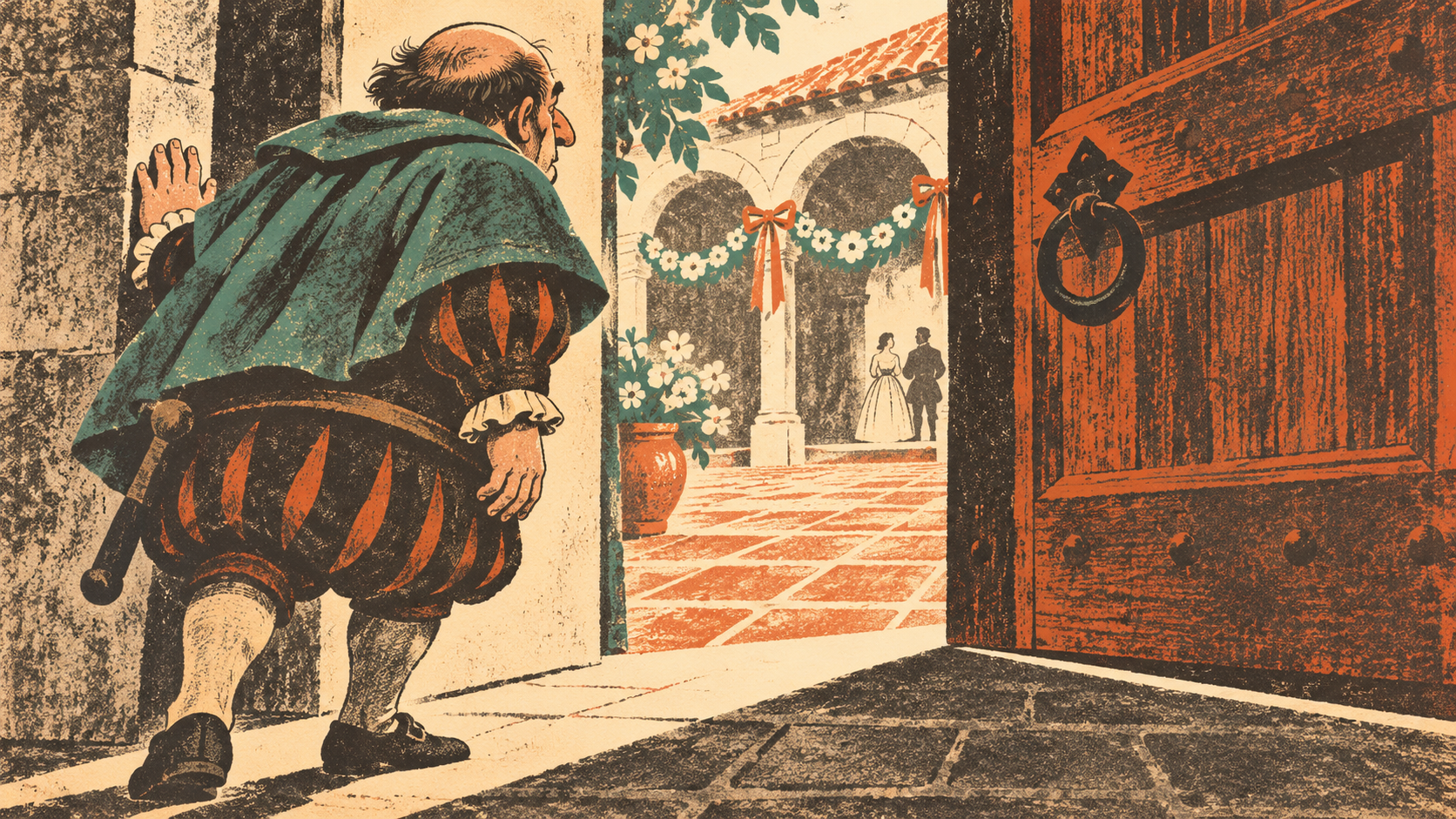
When Dogberry finally asks for the men to be examined before Leonato, Leonato tells him to conduct the examination and bring the result. The wedding pulls him away. Dogberry has reported the arrests, but their connection to Hero remains unheard. Shakespeare puts this near miss immediately before the wedding scene. The audience carries the truth into the ceremony and watches Claudio speak with the confidence of someone who has heard only one account.
If you are comparing scenes in an essay, track what a character knows at the moment they speak. Leonato’s impatience makes the audience anxious because they have heard Borachio’s story. For Leonato, there are prisoners to examine and a daughter to give away.
The evidence reaches two hearings
Night patrol · 3.3
The Watch hears Borachio explain that Claudio took Margaret for Hero.
Before the wedding · 3.5
Leonato hears: The Watch has taken two men.
His next step: He delegates the examination and leaves for the wedding.
After the wedding · 4.2
The Sexton hears: The Watch reports the payment and the plan to shame Hero.
His next step: He takes the examination to Leonato.
Face to face · 5.1
Borachio confirms the deception to Don Pedro and Claudio.
How the Watch’s testimony clears Hero
In Act 4, Scene 2, Dogberry’s questioning goes in circles. He asks the prisoners whether they are knaves and tries to make something of the fact that both say they are innocent. The Sexton changes the procedure by calling for the Watch. Once the witnesses speak, the examination has a sequence to follow. They report Don John’s payment to Borachio and Claudio’s intention to disgrace Hero. The Sexton leaves to show Leonato the examination.

Dogberry has his own idea of what the record should contain. Conrade calls him an ass, and the constable wishes the Sexton were there to “write me down an ass”. He means to have the insult put on record. His phrasing makes him sound as though he is asking for an official judgement on his own character. The seriousness with which he takes his office gives the actor something to play underneath the joke. A man proud of his position has just been ridiculed in front of the people he is meant to command.
In Act 5, Scene 1, Dogberry presents the prisoners to Don Pedro and Claudio. Don Pedro mimics his jumbled list of offences, then questions the prisoners directly. Borachio admits that he deceived them and calls the people who overheard him “shallow fools”. The insult hangs oddly beside the success he has to acknowledge. The Watch brought forward the evidence that makes Claudio see how he wronged Hero. Dogberry still wants the insult against him remembered. The discovery can move the plot towards reconciliation without curing the constable of wounded pride.
Close-reading exercise and answers
Reread Act 3, Scene 5 from Leonato’s “Brief, I pray you” to Dogberry’s request for the prisoners to be examined. Imagine the audience has just watched the arrests. Mark the point where Verges comes closest to giving Leonato the news and the moment Dogberry takes over.
- What word could replace “odorous”, and why does the familiar expression help the joke land?
- How would you deliver “One word, sir” so the audience feels the urgency of the visit? Give one choice of pace, movement or emphasis.
- Does Leonato’s decision leave the case untouched? Explain what he asks Dogberry to do and what difference the timing makes.
Reasoned answers
1. Odious. The saying warns that comparisons can offend. The similar sound lets Dogberry get nearly all the way through a familiar formula before the last word makes us picture a smell. He is also trying to stop Verges talking, which gives his own slip a target and a consequence.
2. Quick and direct. An actor could step towards Leonato and say the words in one breath as Leonato turns to go. The change of pace would give the audience a moment to think Dogberry might get the whole story out in time. The repeated “sir” as he reports the arrests could sound like a last attempt to hold a superior’s attention.
3. The case proceeds on a different timetable. Leonato delegates the examination and asks to see the result. The evidence takes time to reach him. The wedding can therefore go ahead with Claudio still convinced of Hero’s guilt. In an essay, pair Leonato’s instruction with the placement of the wedding scene to show how dialogue and scene order work together.
Dogberry is a good test of whether a character paragraph can move from a single word to the shape of a scene. Begin with what the actor has to say, then follow what the other characters can do with what they hear. The course offers a place to continue that close reading across the play.